 العربية
Medical Laboratory Program
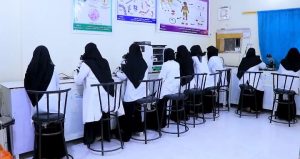
The Medical Laboratory Technician Diploma Program at the Applied College of Science and Technology seeks to prepare academically qualified professionals who can meet community needs by providing distinguished scientific education of high academic quality.
The program is also delivered through a distinctive educational strategy designed to create a stimulating learning environment for curriculum delivery, supported by modern medical equipment and technologies available in Yemen.
■ Program Establishment
The program was established in 2019.
■ Graduating Qualified Professionals
The program has graduated several cohorts of qualified medical laboratory technicians.
■ High Competitiveness
Program graduates demonstrate strong competitiveness in the local and regional labor market.
■ Diverse Career Fields
Graduates perform vital roles in healthcare, educational, and research sectors, as well as in specialized laboratories locally and abroad.
■ Community Service
The program contributes to various community-service activities, including free medical testing and health awareness initiatives.
▍ Program Vision / Mission
The Medical Laboratory Technician Program seeks to prepare and graduate highly competent specialists in laboratory diagnostics who are capable of supporting distinguished healthcare services in accordance with the highest academic and professional standards. This is achieved by equipping students with contemporary knowledge and advanced skills, guided by Islamic values, while encouraging distinguished scientific research that keeps pace with scientific progress and contributes positively to the development needs of society.
Objectives of the Medical Laboratory Technician Department
- 1. Equip students with scientific knowledge and professional skills in medical laboratory sciences.
- 2. Prepare qualified professionals trained to use modern medical equipment and specialized in laboratory diagnostics.
- 3. Apply Islamic values in professional medical practice.
- 4. Contribute to promoting health awareness within the community and develop students’ professional conduct in dealing with all members of society.
- 5. Participate effectively in activities aimed at providing healthcare and preventive services.
- 6. Establish effective relationships and partnerships with relevant institutions.
- 7. Contribute to providing distinguished healthcare and research services to help address community health problems.
University of Science and Technology
Intended Learning Outcomes of the Medical Laboratory Technician Program (ILOs)
A
Knowledge & Understanding
- Demonstrate knowledge of the fundamental concepts and information in medical laboratory sciences.
- Compare patient results obtained through different laboratory systems to verify the validity and accuracy of results.
- Read and understand written and visual data displayed on screens and prepare laboratory reports efficiently.
- Apply safety and infection-prevention procedures when handling biological samples and laboratory materials in accordance with standard precautions.
- Understand specialized laboratory subjects theoretically and practically in line with modern scientific developments.
- Understand laboratory tests, their abbreviations, significance, methods of specimen collection, and interpretation of results.
B
Intellectual Skills
- Accurately interpret the results of different laboratory tests.
- Review and critically evaluate manual laboratory procedures, including patient preparation, specimens, reagents, testing procedures, result calculations, and quality assurance.
- Prepare and deliver scientific discussion sessions for students, members of the medical team, and the community.
- Estimate the financial cost of laboratory tests requested by physicians.
- Develop awareness of environmental issues, pollution, and common diseases in the community.
- Collect, prepare, and analyze specimens and interpret results with a high level of competence.
- Plan quality-assurance protocols for monitoring equipment and procedures, identify errors, integrate and evaluate data, and solve problems.
C
Practical & Professional Skills
- Collect specimens from patients professionally and safely[cite: 4].
- Differentiate between chemical and biological samples based on their physical and chemical characteristics[cite: 4].
- Operate and use advanced laboratory equipment effectively and responsibly while applying quality systems[cite: 4].
- Conduct laboratory experiments and scientifically interpret test results[cite: 4].
- Apply the principles of scientific research and statistics using information technology[cite: 4].
D
General & Transferable Skills
- Work effectively as part of a team and participate in providing healthcare services to people of all groups and ages[cite: 4].
- Respect patients, supervisors, and colleagues while maintaining complete confidentiality and privacy in professional interactions[cite: 4].
- Recognize the personal and social responsibilities of medical laboratory professionals[cite: 4].
- Promote a culture of teamwork and continuously adapt to scientific and technological developments[cite: 4].
University of Science and Technology
Graduate Profile and General Attributes – Medical Laboratory Technician Program
Key Graduate Attributes:
- ■
Application of Knowledge and Skills: Apply knowledge and skills relevant to the specialization with a high level of competence[cite: 5]. - ■
Safe and Ethical Practice: Practice safely and effectively in accordance with the highest ethical and professional standards. - ■
Knowledge of Common Diseases: Demonstrate comprehensive understanding of common diseases, including their causes, modes of transmission, and prevention methods. - ■
Independent Practice: Work independently in healthcare centers and perform general laboratory analyses on specimens. - ■
Data Integration and Interpretation: Collect, correlate, and interpret data based on knowledge derived from practical results. - ■
Patient-Centered Awareness and Healthcare Integration: Recognize the roles of clinical laboratory specialists and contribute to a healthcare delivery system focused on the patient. - ■
Operation and Maintenance of Laboratory Equipment: Operate laboratory medical equipment correctly, perform routine preventive maintenance, identify problems, and carry out appropriate troubleshooting. - ■
Distinguishing Pathological and Normal Conditions: Distinguish normal conditions from pathological changes through the analysis of different specimens. - ■
Professional Relationships and Ethics: Maintain respectful personal and professional relationships with all healthcare workers, understand patient rights, and protect patient confidentiality. - ■
Use of Technology and Modern Systems: Use computers and information technology in modern laboratory practice. - ■
Laboratory Problem-Solving Skills: Identify problems that may arise in the laboratory or during testing and determine appropriate solutions. - ■
Citizenship and Social Responsibility: Demonstrate responsible citizenship, strengthen national identity, and engage with contemporary community issues and affairs.