
 العربية
Emergency Medicine Program
Developing an educational program that keeps pace with continuous advancements in emergency medicine and prepares emergency medicine specialists who are capable of competing at the local and regional levels. The College aspires to achieve excellence and leadership in the field of emergency medicine.
Achievements of the Emergency Medicine Diploma Program
The Emergency Medicine Diploma Program aims to prepare technically qualified healthcare professionals who are scientifically, practically, and professionally competent to provide safe and efficient initial and emergency care to patients and injured persons, contribute to saving lives and reducing complications, and work effectively within the emergency care team through the following::
- Prepare professionals with fundamental knowledge in emergency sciences and related medical sciences.
- Equip students with skills in rapid and systematic patient assessment and identification of life-threatening conditions.
- Train students to apply basic and advanced resuscitation principles according to their approved training level and scope of practice.
- Develop the ability to provide initial management of injuries, accidents, and acute medical conditions.
- Equip students with skills to manage choking, respiratory disorders, and circulatory emergencies.
- Train students in the initial management of bleeding, shock, and various injuries.
- Develop skills in safe stabilization and transportation of patients and injured persons.
- Equip students with skills in using basic emergency devices and equipment.
- Enhance the ability to recognize critical cases early and request appropriate medical intervention.
- Develop infection control and patient safety skills in emergency settings.
To create a disciplined university environment that prepares graduates who excel ethically, scientifically, professionally, and in research within the field of emergency medicine, enabling them to contribute to diagnosis, community health development, and the provision of competent healthcare professionals capable of meeting labor market needs and supporting development plans.
1- Prepare and graduate highly qualified specialists who meet labor market needs in the field of emergency medicine.
2- Equip students with the scientific and practical skills required to operate diagnostic equipment and ensure quality in emergency care in line with scientific advancements in the specialty.
3- Encourage and support students in conducting research and actively participating in specialized training programs.
4- Engage students in promoting community health awareness regarding infectious and endemic diseases, particularly in Al Hodeidah Governorate and generally across Yemen.
5- Graduate healthcare professionals capable of conducting evidence-based practice research in the field of emergency medicine.
6- Graduate specialists who work effectively within the medical team to improve patient outcomes.
7- Contribute to the development of emergency medicine through participation at the local level.
- Perform rapid and systematic initial assessment of the patient or injured person.
- Identify life-threatening conditions and manage them according to approved protocols.
- Assess the airway, breathing, circulation, and neurological status.
- Measure vital signs and monitor changes in the patient’s condition.
- Perform a secondary assessment after stabilization of life-threatening conditions.
- Apply triage principles and determine case priority.
- Provide first aid and basic emergency care.
- Perform cardiopulmonary resuscitation according to the approved level of training.
- Use an automated external defibrillator when available and within the scope of training.
- Provide initial support to patients experiencing respiratory distress.
- Provide initial management of bleeding and shock.
- Provide initial management of injuries, fractures, and wounds.
- Apply spinal immobilization procedures when spinal injury is suspected, according to approved protocols.
- Provide initial care for burns, drowning, poisoning, and environmental injuries.
- Recognize medical emergencies such as altered levels of consciousness, seizures, chest pain, shortness of breath, and other acute conditions.
- Provide initial emergency care for children, pregnant women, and older adults within the scope of training.
- Prepare the patient for safe transportation to the appropriate healthcare facility.
- Monitor the patient during transport and document the patient’s condition and interventions provided.
- Use basic emergency devices and equipment correctly and safely.
- Collaborate with physicians, nurses, and other members of the emergency care team.
- Recognize cases that exceed the scope of practice or competence and immediately notify the physician or appropriate team.
- Accurately document emergency procedures and observations.
- Maintain patient confidentiality, privacy, and dignity.
- Adhere to professional ethics, regulations, and approved protocols.
Upon completing the program, the graduate should demonstrate the following attributes:
- Scientific Competence
Possesses fundamental knowledge of medical sciences, emergency care, and first aid.
- Emergency Care Competence
Able to provide initial emergency care within the defined scope of practice.
- Rapid Assessment
Able to perform rapid and systematic patient assessment and identify life-threatening conditions.
- Resuscitation Competence
Possesses basic cardiopulmonary resuscitation skills and can respond to cardiac and respiratory arrest according to the level of training.
- Injury Management
Able to provide initial care to injured persons, control bleeding, stabilize injuries, and transport patients safely.
- Working Under Pressure
Able to work efficiently in environments that require rapid response, composure, and accuracy.
- Teamwork
Able to collaborate effectively with physicians, nurses, paramedics, and other healthcare team members.
- Safety and Infection Control
Committed to infection control procedures, patient safety, and occupational safety.
- Communication
Possesses effective communication skills with patients, their families, and the healthcare team.
- Professionalism
Committed to professional ethics, confidentiality, patient rights, and professional responsibility.
- Adherence to Scope of Practice
Recognizes the limits of professional competence and authority and seeks medical assistance or referral when a case exceeds the scope of practice.
- Lifelong Learning
Able to continuously develop knowledge and skills and keep up with protocols and developments in emergency care.
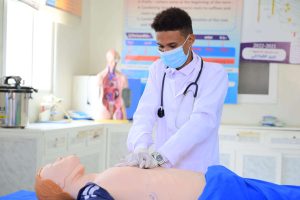
To be awarded the three-year Emergency Medicine Diploma, the student must fulfill all approved academic, practical, clinical, and professional requirements, including the following:
- Successfully complete all courses specified in the study plan.
- Achieve the required minimum cumulative GPA.
- Successfully complete all theoretical and practical courses.
- Complete clinical training in emergency departments and accredited healthcare facilities.
- Complete the required training and clinical hours specified in the study plan.
- Pass the clinical and practical skills assessment.
- Pass structured skills examinations such as OSCE or equivalent practical examinations.
- Complete training in cardiopulmonary resuscitation and first aid according to approved requirements.
- Complete training in the use of basic emergency devices and equipment.
- Complete field training or internship if required by the study plan.
- Complete a graduation project or applied research if required by the study plan.
- Fulfill attendance requirements and maintain academic and clinical discipline.
- Comply with professional registration and licensing requirements set by the relevant authorities.
- 1. Clinical Work in Hospitals – Emergency Departments (ER): Receiving and triaging critical cases, traffic accidents, and severe injuries in public and private hospitals.
2– Intensive Care Units (ICU): Providing care for critically ill patients, supported by advanced skills in airway management and resuscitation.
3– Urgent Care Centers: Working in medical centers and clinics that manage semi-critical cases that do not require admission to a general hospital.
4- Field and Emergency Medical Services – National Ambulance Authorities.
5– Working as an Emergency Medical Services (EMS) specialist, advanced paramedic, or supervisor in emergency operations and dispatch centers.
6– Air Medical Evacuation: Providing care and accompanying critically ill patients during transport in medically equipped aircraft. 7- Rapid Response Teams: Working with humanitarian and relief organizations, such as the Red Crescent, in areas affected by natural disasters and conflict.
8- Industrial Sector and Companies – Oil Companies and Mining Areas: Serving as a medical officer in fields, offshore platforms, and remote sites to ensure worker safety and provide immediate treatment for occupational injuries. Tourism companies.
9- Maritime Lines: Managing medical clinics aboard large cruise ships and providing medical coverage during maritime travel.
10- Events and Mass Gatherings: Organizing and providing emergency medical coverage at sports stadiums, entertainment venues, and tourism and religious seasons.
11– Working as a certified instructor to deliver basic and advanced life-support courses such as BLS, ACLS, PALS, and ATLS. 12. Health Administration and Planning – Disaster and Crisis Management.
13– Participating in national emergency plans for epidemics or major incidents, and managing and coordinating emergency departments to ensure the readiness of medical teams and supplies within ER units.