
 العربية
Pharmacy Program
It is an applied health program that aims to prepare scientifically and professionally qualified pharmacy personnel to work in various areas of pharmaceutical services by integrating theoretical knowledge with practical and field training.
The Pharmacy Technician Program operates within the Applied College of Science and Technology and seeks to develop the educational and training process in the pharmaceutical field in line with labor market needs and healthcare sector requirements.
Key Achievements and Areas of Development:
- Providing an appropriate and stimulating educational environment for learning and training.
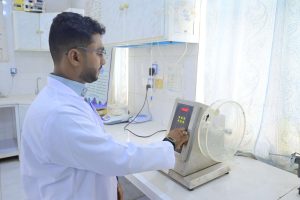
- Providing well-equipped and advanced pharmaceutical laboratories for practical application.
- Providing qualified staff to teach and train students in the pharmaceutical field.
- Emphasizing practical applications and field training in pharmacies.
- Organizing annual visits to pharmaceutical factories to strengthen students’ practical experience.
- Establishing partnerships with hospitals and pharmacies to qualify students and develop their professional skills.
- Preparing students to work in pharmaceutical storage, drug warehouses, and pharmacies.
- Preparing qualified pharmacy personnel capable of delivering pharmaceutical services and serving the community
Preparing scientifically and professionally qualified pharmacy technicians who are capable of providing pharmaceutical services efficiently and responsibly, handling, storing, and dispensing medications in accordance with professional standards and procedures, while adhering to professional values and ethics in a manner that contributes to meeting labor market needs and serving the community.
1- Prepare and graduate highly qualified specialists who meet labor market needs in the field of pharmacy.
2- Equip students with the scientific and practical skills required to use relevant equipment and ensure quality in pharmacy practice in line with scientific advancements in the specialty.
3- Encourage and support students in conducting research and actively participating in specialized training programs.
4- Engage students in promoting community health awareness regarding infectious and endemic diseases, particularly in Al Hodeidah Governorate and generally across Yemen.
5- Graduate healthcare professionals capable of conducting evidence-based practice research in pharmaceutical sciences.
6- Graduate specialists who work effectively within the healthcare team to improve patient outcomes.
7- Contribute to the development of pharmacy through participation at the local level.
Knowledge and Understanding
- A1
Explain the basic concepts and principles of pharmaceutical sciences. - A2
Identify medications, their uses, and pharmaceutical dosage forms. - A3
Explain the principles of proper medication storage and preservation. - A4
Explain the rules, regulations, and professional ethics governing pharmacy practice.
Professional and Practical Skills
- B1
Handle medications and pharmaceutical preparations safely. - B2
Contribute to dispensing medications in accordance with regulations and instructions under appropriate professional supervision. - B3
Apply principles of storage, organization, and inventory control in pharmacies and drug warehouses. - B4
Use pharmaceutical tools and equipment efficiently and safely. - B5
Apply acquired practical skills in pharmacies and healthcare facilities.
Communication and Professional Practice Skills
- C1
Communicate effectively with patients, clients, and healthcare professionals. - C2
Work effectively within the healthcare team. - C3
Adhere to professional ethics and maintain confidentiality of information.
Community Service and Professional Practice
- D1
Contribute to pharmaceutical services and community service. - D2
Contribute to raising awareness of the safe and proper use of medications. - D3
Apply safety and quality procedures in the pharmaceutical workplace.
Learning and Professional Development
- E1
Apply pharmaceutical knowledge and skills to solve professional problems. - E2
Benefit from field training and scientific visits to pharmaceutical factories to develop professional skills. - E3
Continue learning and self-development and keep pace with developments in the pharmaceutical field.
Graduate Attributes
A graduate of the Pharmacy Technician Program is a scientifically and professionally qualified pharmacy technician who possesses the knowledge and skills required to work in various areas of pharmaceutical services and is able to:
- •
Handle medications and pharmaceutical preparations safely and responsibly. - •
Contribute to dispensing medications in accordance with regulations and instructions under appropriate professional supervision. - •
Apply appropriate principles for storing, organizing, and preserving medications. - •
Work efficiently in pharmacies, drug warehouses, and healthcare facilities. - •
Use pharmaceutical tools and equipment correctly and safely. - •
Apply acquired theoretical knowledge and practical skills in the workplace. - •
Contribute to pharmaceutical services and community service. - •
Communicate effectively with patients, clients, and members of the healthcare team. - •
Adhere to professional ethics, laws, and regulations governing pharmacy practice. - •
Work effectively as part of a team and assume professional responsibility. - •
Maintain medication safety and quality during storage and handling. - •
Continue learning and professional development and keep pace with developments in the pharmaceutical field.
To be awarded the three-year Pharmacy Technician Diploma, the student must fulfill all approved academic, training, and professional requirements, including the following:
- Successfully complete all compulsory and elective courses in the study plan.
- Achieve the minimum cumulative GPA approved by the educational institution.
- Successfully complete theoretical and practical courses.
- Complete the required practical and clinical training.
- Complete training in community pharmacies, hospital pharmacies, or accredited healthcare facilities.
- Pass the basic practical skills assessment.
- Pass structured practical examinations such as OSPE/OSCE if adopted by the program.
- Complete field/applied training according to the hours specified in the study plan.
- Complete a graduation project or applied research if required by the study plan.
- Fulfill safety and infection control requirements.
- Fulfill attendance requirements and maintain academic and training discipline.
- Fulfill professional registration or licensing requirements set by the relevant authorities.
Program Knowledge Areas
- •
Fundamentals of pharmacy and pharmaceutical terminology. - •
Pharmacology, medication classifications, uses, and basic effects. - •
Pharmaceutics and preparation of various pharmaceutical products and dosage forms. - •
Pharmaceutical chemistry and biochemistry related to pharmacy practice. - •
Pharmacognosy, medicinal plants, and sources of medicinal substances. - •
Dosage calculations, pharmaceutical quantities, and preparation methods. - •
Methods of preserving and storing medications and monitoring their expiry and quality. - •
Dispensing medications and handling prescriptions in accordance with approved authority and regulations. - •
Rational and safe use of medications and patient medication counseling. - •
Infection control and occupational safety in the pharmaceutical work environment. - •
Management and organization of pharmacies and drug warehouses and maintenance of records. - •
Fundamentals of drug interactions, adverse effects, and medication-related precautions. - •
Professional ethics, confidentiality of information, and patient rights. - •
Practical and field training in pharmacies and healthcare institutions.
Career Opportunities
- •
Public and private pharmacies. - •
Hospital and medical center pharmacies. - •
Drug and medical supply warehouses. - •
Pharmaceutical warehouses and distribution organizations. - •
Pharmaceutical and medical supply companies and institutions. - •
Health institutions, organizations, and programs related to pharmaceutical services. - •
Health centers and primary healthcare clinics within the scope of practice. - •
Contribute to receiving, organizing, storing, and monitoring the expiry of medications. - •
Contribute to preparing and dispensing medications according to prescriptions, instructions, and approved authority. - •
Contribute to managing and organizing records and pharmaceutical inventory and monitoring medication movement. - •
Contribute to providing basic medication education and guidance to patients under the supervision of a pharmacist.