
 العربية
Nursing Program
The Nursing Program aims to prepare qualified healthcare professionals equipped with the knowledge and clinical and professional skills required to contribute to the delivery of safe and effective healthcare services, work as part of the medical team, and practice under the professional supervision and responsibility of the physician.
The Nursing Diploma Program was established at the Applied College to prepare and graduate technically competent nursing professionals who are academically, scientifically, and professionally qualified in accordance with the needs of the labor market and healthcare sector, and to equip them with the knowledge and skills required to compete effectively and contribute to the development of healthcare.
Key milestones and areas of development and excellence in the program:
- Graduating successive cohorts of qualified and trained nursing professionals to meet the needs of healthcare institutions.
- Enhancing professional practice and reinforcing the principles of professional ethics, infection control, and patient safety.
The Nursing Program seeks to prepare and graduate highly competent healthcare professionals who are scientifically and professionally qualified and capable of providing distinguished nursing care in accordance with the highest academic and professional standards, by equipping them with contemporary knowledge and advanced skills in light of the values of our Islamic faith, while contributing to scientific research, community service, and development in a manner that meets the needs of the healthcare sector and labor market.
General and Professional Objectives of the Nursing Program
1. Provide students with scientific knowledge and advanced nursing skills in accordance with the highest standards of academic quality.
2. Prepare qualified nursing professionals who are efficiently trained in the use of the latest medical devices and technologies.
3. Apply Islamic values and high professional ethical standards in healthcare practice.
4.Qualify graduates to provide comprehensive and integrated nursing care across various medical, critical care, and emergency departments.
5.Promote health awareness and strengthen primary healthcare and maternal and child health programs within the community.
6. Actively participate in distinguished preventive and research activities that contribute to addressing community health problems.
7. Build effective professional partnerships and relationships with healthcare institutions and accredited hospitals to enhance training and employment opportunities.
- Explain the fundamental principles of medical and biomedical sciences related to clinical practice.
- Describe the structure and functions of the human body in health and disease.
- Explain the pathological mechanisms of common diseases and health conditions.
- Identify the clinical signs and symptoms of the most common diseases.
- Interpret basic laboratory and diagnostic test results in light of the clinical condition.
- Explain the basic principles of pharmacology and the safe use of medications.
- Demonstrate knowledge of microbiology and infection control principles.
- Explain the principles of nutrition, public health, and disease prevention.
- Explain the principles of diagnosis, treatment, and follow-up for common medical conditions.
- Demonstrate knowledge of emergency medicine, first aid, and basic life support.
- Explain the principles of surgery and basic clinical procedures within the scope of physician assistant practice.
- Demonstrate knowledge of the basic principles of care for children, women, and older adults.
- Understand the principles of primary healthcare and community health.
- Demonstrate knowledge of professional ethics, healthcare laws, and regulations.
- Explain the principles of patient safety and healthcare quality assurance.
- Understand scientific research methods and evidence-based medicine.
- Demonstrate knowledge of the use of information systems and digital technologies in healthcare.
Upon completing the program, the graduate should demonstrate the following attributes:
- Scientific Competence
Possesses integrated knowledge of the basic and clinical medical sciences required for professional practice.
- Clinical Competence
Able to perform basic clinical assessment and contribute to the diagnosis, treatment, and follow-up of patients within the scope of practice.
- Clinical Reasoning
Able to analyze clinical information, identify health problems, and make appropriate decisions within the limits of professional competence.
- Emergency Competence
Able to recognize critical conditions, provide an initial response, seek medical assistance, and arrange appropriate referral.
- Patient Safety
Committed to applying safety standards, infection control measures, and prevention of medical errors.
- Communication
Possesses effective communication skills with patients, their families, and the healthcare team.
- Teamwork
Able to work efficiently within a multidisciplinary team and under medical supervision in accordance with approved regulations.
- Professional Ethics
Committed to confidentiality, privacy, respect, patient rights, professional responsibility, and accountability.
- Patient-Centered Care
Provides care while considering the patient’s psychological, social, and cultural needs.
- Evidence-Based Practice
Able to access, evaluate, and apply reliable medical information in practice.
- Use of Technology
Able to use electronic health records, information systems, and relevant medical technologies.
- Lifelong Learning
Demonstrates a positive attitude toward continuous professional development and updating knowledge and skills.
- Social Responsibility
Able to contribute to prevention programs, health promotion, primary healthcare, and community service.
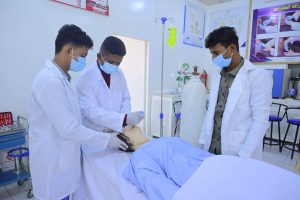
To be awarded the Medical Assistant degree or the academic qualification approved for the program, the student must fulfill all academic, clinical, and professional requirements specified by the University and the relevant regulatory authorities, including the following:
- Successfully complete all compulsory and elective courses in the study plan.
- Achieve the approved minimum cumulative GPA.
- Successfully complete theoretical, practical, and clinical courses.
- Complete clinical training in accredited hospitals and health centers.
- Complete the required number of clinical hours or experiences.
- Pass the practical clinical skills assessment.
- Pass structured practical examinations such as OSCE when adopted in the program.
- Successfully complete field training/clinical internship if required by the study plan.
- Fulfill the requirements for first aid and basic life support.
- Complete a graduation project or scientific research if required by the study plan.
- Comply with attendance requirements and academic and clinical discipline.
- Fulfill any licensing or professional registration requirements imposed by the relevant regulatory authority.
- Government Hospitals.
- Private Hospitals.
- Medical Centers.
- Health Centers.
- Primary Care Clinics.
- Outpatient Clinics.
- Emergency Departments.
- Specialized Clinics within the Scope of Practice and Supervision.
- Maternal and Child Health Centers.
Primary and Community Healthcare
- Primary Healthcare Centers.
- Community Health Programs.
- Disease Prevention Programs.
- Chronic Disease Control Programs.
- Maternal and Child Health Programs.
- Health Education Programs.
- Vaccination and Public Health Campaigns.
Humanitarian and Health Organizations
- Non-Governmental Organizations.
- International Organizations.
- Humanitarian Health Programs.
- Primary Healthcare Projects.
- Emergency and Disaster Programs.
- Community Health Projects.
Clinical and Administrative Fields
With appropriate experience and qualifications, the graduate may participate in:
- Healthcare Services Coordination.
- Management of Clinics and Health Units.
- Quality and Patient Safety.
- Infection Control.
- Health Education.
- Health Records and Information.
- Community Health Programs.