 العربية

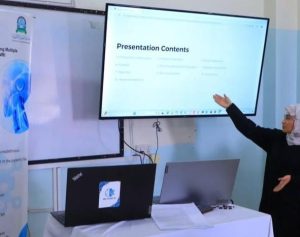
Sana’a- In a distinguished academic achievement bridging technology and medicine, female students specializing in Software Engineering at the Faculty of Computing and Information Technology, University of Science and Technology (UST) in Sana’a, presented a qualitative graduation project entitled: “Intelligent System for Diagnosing Multiple Sclerosis Using Brain MRI.”
The project aims to design and develop an intelligent system that supports the diagnosis of Multiple Sclerosis (MS) by relying on the analysis of brain magnetic resonance imaging (MRI) scans using artificial intelligence and deep learning techniques.
Objectives and Features of the Intelligent System:
-
Automated Detection: Automated detection of multiple sclerosis lesions in MRI scans.
-
Lesion Analysis: Analyzing lesion characteristics in terms of number, size, shape, and orientation.
-
Condition Classification: Classifying the condition into three grades: definite, probable, or possible diagnosis.
-
Comprehensive Medical Reporting: Generating comprehensive and automated medical reports linked to electronic health records (EHR).
-
Progress Tracking: Comparing current images with previous ones to monitor the progression of the medical condition.
The importance of the project lies in its support for early and accurate diagnosis, reducing the burden on neurologists—especially in areas suffering from a shortage of specialized personnel. It also represents an important step toward employing artificial intelligence technologies in the local health sector.
“This project embodies an exemplary model for students of the Faculty of Computing and Information Technology, and affirms the capability of young talents to provide innovative technical solutions that serve the community and develop the health sector.”
This statement was highlighted as a student from the Software Engineering specialty reviewed the main axes of her graduation project during the public defense at the Faculty of Computing and Information Technology.