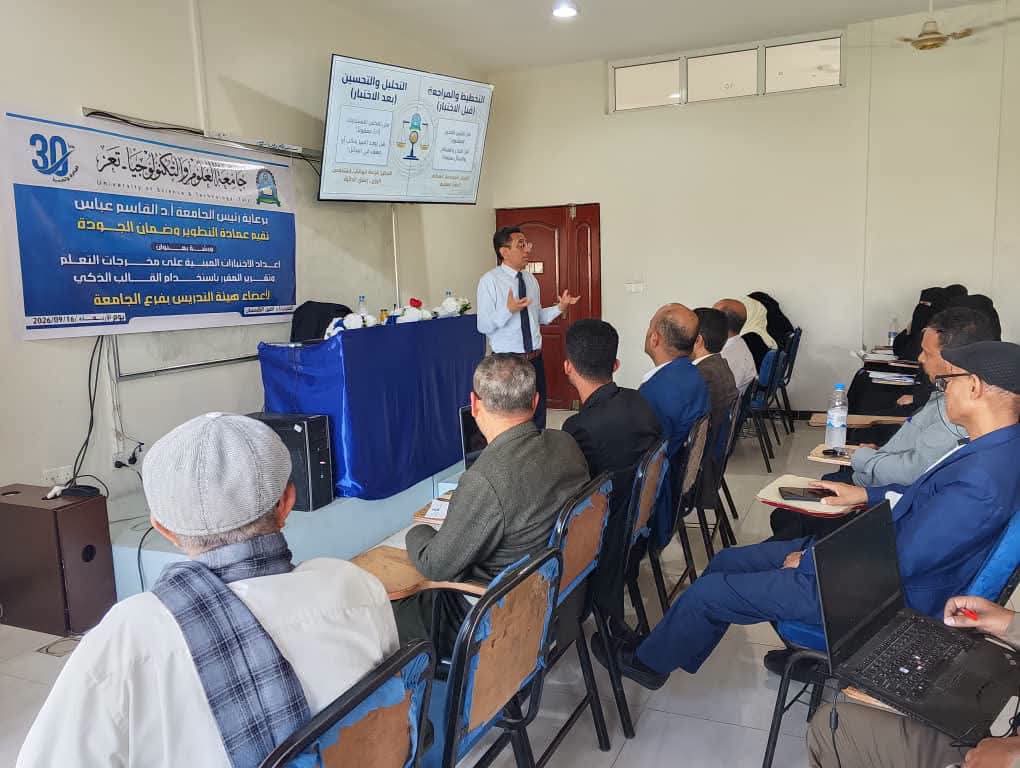
Sana'a — The Deanship of Development and Quality Assurance at the University of Science and Technology, in coordination and cooperation with the University’s branches in the governorates of Ibb, Taiz, and Hudaidah, carried out a series of specialized training workshops for academic staff on “Preparing Learning Outcomes-Based Exams and Course Reports Using the Smart Template,” during the period from 15 to 19 September 2026, within the University’s efforts to develop academic and assessment practices and enhance quality standards and academic accreditation.
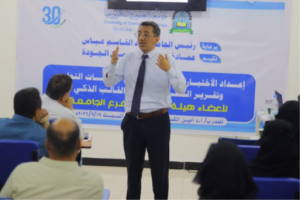
The workshops targeted faculty members and academic staff in the three branches and were presented by Prof. Dr. Amin Mohammed Al-Kastaban, Dean of Development and Quality Assurance at the Main Center. They focused on developing participants’ skills in building exams according to learning outcomes, analyzing their results, and preparing course reports, thereby enhancing the use of assessment results in continuous improvement processes of the educational process.
The workshops witnessed wide participation from academic staff; the number of participants in Ibb Branch reached 49 participants from various scientific departments, while 49 participants took part in the Taiz Branch workshop, and the number of participants in Hudaidah Branch reached 38 participants from faculty members and academic staff.
Training Axes to Enhance the Quality of Exams and Assessment
The workshops addressed a number of applied axes, including building exams according to learning outcomes (CILOs), by linking exam questions to course outcomes and determining their relative weights, in addition to introducing the importance of pre- and post-assessment of exams, analyzing their results, and measuring the extent to which targeted learning outcomes are achieved.
The workshops also included introducing the Smart Template for the Question Bank, reviewing its components and technical items, and the mechanism for entering questions and generating exam models in an organized and automated manner, in addition to addressing the criteria for peer review of exams (Peer Review) and its role in verifying the quality, clarity, comprehensiveness, and cognitive and skill balance of exams.
They also addressed the mechanism for preparing the Course Report after recording grades and analyzing results, according to the forms and procedures approved by the University, allowing the use of assessment results in identifying aspects of improvement and supporting the preparation of annual development plans.
Leadership Meetings to Enhance Participation in the University’s Strategy
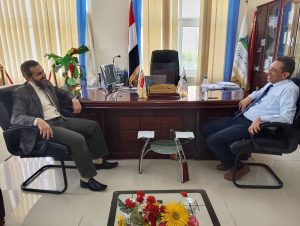
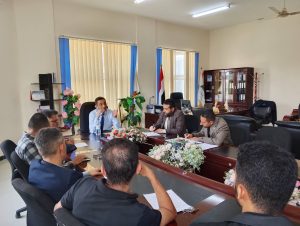
On the sidelines of the training workshops, the Deanship of Development and Quality Assurance held leadership and development meetings with branch administrations and heads of scientific departments, addressing the University’s new strategy and projects related to its initiatives, reviewing operational plans, and enhancing the role of scientific departments in participating in developmental initiatives and projects.
The meetings emphasized the importance of the effective participation of scientific departments in reviewing and enriching projects in line with field and specialized needs, and updating operational plans to ensure accuracy of implementation and effectiveness of follow-up.
The meetings also discussed the branches’ plans to complete the application and generalization of the Smart Template for the Question Bank in courses and academic programs, activate learning outcomes in designing study plans and exams, and enhance the role of peer review in supporting exam quality and achieving academic accreditation requirements.
Recommendations to Enhance Continuous Improvement
The workshops and meetings concluded by emphasizing the generalization and activation of the Smart Template for the Question Bank in various courses and academic programs, continuing the implementation of training programs and refresher meetings for academic staff, activating peer review committees, and auditing exam models before their approval.
The recommendations also emphasized the importance of adhering to preparing and submitting course reports according to approved forms and deadlines, and benefiting from their results in building improvement and development plans, in addition to enhancing coordination and cooperation between development and quality assurance units in the branches and the Deanship of Development and Quality Assurance at the Main Center, and providing technical support to scientific departments to overcome challenges related to building question banks and preparing course reports.
These workshops and meetings come within the efforts of the University of Science and Technology, represented by the Deanship of Development and Quality Assurance, in supporting academic development, raising the efficiency of academic staff, consolidating the culture of quality and continuous improvement, and enhancing the readiness of academic programs for the requirements and standards of academic accreditation.