
 العربية
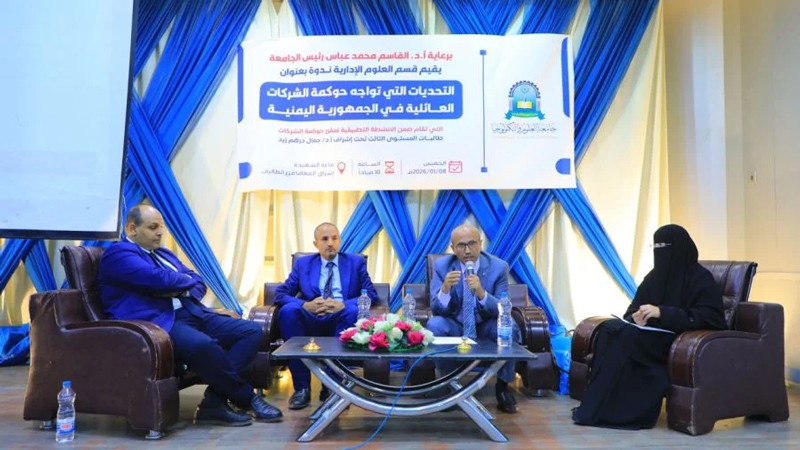
Sana’a – The Administrative Sciences Department at the Faculty of Administrative and Human Sciences – University of Science and Technology (UST) in Sana’a organized a scientific symposium titled “The Challenges Facing Family Business Governance in the Republic of Yemen”, as part of the practical activities for the Corporate Governance course, in the presence of an elite group of academics, economic experts, and private sector representatives.
At the opening of the symposium, held at the Girls’ Branch, Prof. Ammar Al-Zahari, Dean of the Faculty, delivered a speech emphasizing the importance of shedding light on family business governance due to its vital role in achieving sustainability, enhancing transparency, and ensuring a successful intergenerational transfer of business. He added that governance helps minimize family disputes, clarify roles and responsibilities, and link performance to accountability to ensure long-term corporate continuity and growth.
Al-Zahari noted that separating ownership from management and establishing clear succession policies are key pillars for family business success, and that effective boards of directors contribute to supporting strategic decisions and protecting family capital.
Furthermore, Mohammed Salah, Vice Chairman of the Chamber of Commerce and Industry in Capital Secretariat, delivered a speech highlighting the importance of institutionalizing governance concepts in Yemeni family businesses, noting their major role in enhancing transparency, ensuring smooth leadership transitions between generations, and preserving national capital. He urged commercial firms and houses to adopt governance and draft family constitutions to ensure survival, sustainability, and future business development. Salah also reviewed various challenges facing the private sector in Yemen, especially amid conflicts and wars, praising the private sector’s resilience and role in supporting the national economy and securing food and medicine for the Yemeni people.
The symposium was moderated by Prof. Dr. Jamal Dirham, Governance Course Professor at the university and Head of Istidama Center for Consulting and Business Services. It featured three main axes:
-
First Axis: “The Legal Status of the Family Constitution”, presented by Dr. Abdulbasit Al-Dharasi.
-
Second Axis: “The Role of the Board of Directors in Family Business Governance”, presented by Dr. Mohammed Shujaa Al-Din.
-
Third Axis: “The Reality of Family Business Governance in Yemen”, presented by Dr. Ilham Hussein.
Additionally, Mohammed Al-Azazi, Director of Governance and Fatwas at Hael Saeed Anam Group, presented the group’s governance experience, emphasizing that it has made great strides in this field and become a role model for commercial companies and institutions in Yemen.
The symposium witnessed remarkable engagement and was enriched by constructive discussions and interventions that praised UST for organizing this qualitative and vital symposium, stressing that family business challenges require institutional awareness of governance importance to enhance survival and development in a changing business environment. Speakers also highlighted the necessity of political and security stability, good governance, and favorable climates for business continuity, while warning against the flight of national capital resulting from conflicts, divisions, and harassment faced by business figures.
The event was attended by an elite group of businessmen, heads and representatives of commercial federations and sectors, the leadership of the Girls’ Branch, and academic and administrative leaders at the university.