
 العربية
Midwifery and Obstetrics Program
The Midwifery and Obstetrics Program is an applied health program that aims to prepare specialized and qualified professionals in maternal and newborn care by integrating theoretical knowledge with practical and clinical training. The program equips students with the skills required to monitor pregnancy, contribute to care during labor and the postpartum period, care for newborns, and identify cases that require referral in accordance with professional standards and the principles of quality and patient safety.
Academic and Clinical Preparation: Integrating theoretical knowledge with practical and field training.
Comprehensive Healthcare: Monitoring the stages of pregnancy, childbirth, the postpartum period, and newborn care.
Commitment to Standards: Identifying cases that require referral and accurately applying quality and patient safety principles.
Midwifery and Obstetrics Program
The Midwifery and Obstetrics Program operates within the Applied College of Science and Technology and seeks to develop the educational and training process in line with labor market needs and healthcare sector requirements, while preparing qualified professionals in maternal and newborn care.
Key Achievements and Areas of Program Development:
- ✓
Providing qualified academic staff specialized in midwifery and obstetrics. - ✓
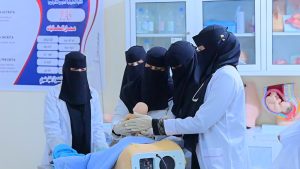
Providing educational laboratories equipped with devices, tools, and simulation models for training in midwifery skills. - ✓
Developing the educational and training environment for students. - ✓
Emphasizing field and clinical training in midwifery and obstetrics. - ✓
Establishing partnerships with public and private hospitals to provide practical training opportunities. - ✓
Integrating theoretical learning with practical and applied training. - ✓
Developing students’ scientific and professional skills in pregnancy, childbirth, and postpartum care. - ✓
Training students in maternal and newborn care and in managing emergency cases within the scope of practice. - ✓
Enhancing health education and counseling skills in maternal and child health and family planning. - ✓
Preparing graduates to participate effectively in healthcare delivery and community service.
To create a disciplined university environment that prepares graduates who excel ethically, scientifically, professionally, and in research in the field of midwifery, and who are capable of contributing to diagnosis, community health development, and the provision of competent professionals in midwifery practice to help meet labor market needs and support development plans.
1- Prepare and graduate highly qualified specialists who meet labor market needs in the field of midwifery.
2- Equip students with the scientific and practical skills required to use relevant diagnostic equipment and ensure quality in line with scientific advances in the specialty.
3- Encourage and support students in conducting research and actively participating in specialized training programs.
4- Engage students in promoting community health awareness regarding infectious and endemic diseases, particularly in Al Hodeidah Governorate and generally across Yemen.
5- Graduate healthcare professionals capable of conducting evidence-based practice research in the field of midwifery.
6- Graduate specialists who work effectively within the healthcare team to improve patient outcomes.
7- Contribute to the development of midwifery through participation at the local level.
A
Knowledge and Understanding
- ▪
A1: Explain the basic concepts and principles of midwifery and obstetrics. - ▪
A2: Explain the stages of pregnancy, childbirth, and the postpartum period and the associated changes. - ▪
A3: Identify warning signs and complications that may affect the mother and newborn. - ▪
A4: Explain the principles of infection prevention and maternal and newborn safety.
B
Professional and Practical Skills
- ▪
B1: Provide integrated care for women during pregnancy, childbirth, and the postpartum period. - ▪
B2: Monitor normal pregnancy and identify cases requiring referral. - ▪
B3: Contribute to conducting normal deliveries in accordance with professional standards. - ▪
B4: Provide essential care for newborns. - ▪
B5: Use medical devices and instruments related to midwifery and obstetrics efficiently and safely.
C
Communication and Teamwork Skills
- ▪
C1: Communicate effectively with women and their families and provide appropriate health counseling. - ▪
C2: Work effectively within the healthcare team. - ▪
C3: Apply the principles and ethics of midwifery practice and maintain the confidentiality of patients’ information.
D
Health Education and Community Service
- ▪
D1: Provide health education related to maternal and child health. - ▪
D2: Provide counseling on family planning, prevention, and health promotion. - ▪
D3: Participate in immunization programs and health and community activities.
E
Learning and Professional Development
- ▪
E1: Apply scientific thinking to solve professional problems. - ▪
E2: Use current scientific resources to improve professional practice. - ▪
E3: Continue learning and self-development and keep pace with developments in midwifery and obstetrics.
Graduate of the Midwifery and Obstetrics Program
She is a scientifically and professionally qualified midwife who possesses the knowledge and skills required to provide safe and comprehensive healthcare for women and newborns and is able to:
- Provide integrated healthcare for women during pregnancy, childbirth, and the postpartum period.
- Monitor normal pregnancy, identify warning signs and complications, and refer cases in a timely manner.
- Contribute to conducting normal deliveries in accordance with professional standards and practices.
- Provide essential newborn care and promote newborn health and safety.
- Manage emergency situations in midwifery within the defined scope of practice.
- Use medical devices and instruments related to midwifery and obstetrics efficiently and safely.
- Apply infection control principles and maternal and newborn safety measures.
- Provide health education and counseling to women and families on maternal and child health and family planning.
- Communicate effectively with patients and their families and work collaboratively with the healthcare team.
- Adhere to midwifery ethics, healthcare laws and regulations, and maintain confidentiality of information.
- Accurately document healthcare provided to the mother and newborn.
- Apply scientific thinking and problem-solving in professional practice.
- Continue learning and professional development and keep pace with developments in midwifery and obstetrics.
- Contribute effectively to healthcare and preventive services and to promoting community health.
- Successfully complete all compulsory and elective courses in accordance with the approved study plan.
- Achieve the minimum cumulative GPA specified by the University.
- Successfully complete theoretical, practical, and clinical courses.
- Complete the required clinical training in various areas of midwifery.
- Complete the required clinical hours or experiences in accordance with the study plan and professional standards.
- Demonstrate competence in essential clinical skills through practical assessment and/or OSCE.
- Successfully complete field training or clinical internship if required by the study plan.
- Complete scientific research or graduation project requirements in accordance with program regulations.
- Fulfill training requirements in first aid and basic life support, as determined by the educational institution and healthcare authorities.
- Comply with attendance requirements and maintain academic and clinical discipline.
1. Fundamentals of midwifery and maternal and newborn care.
1. Maternity and obstetrics and gynecology departments in public and private hospitals.
7. Primary healthcare centers and units.