
 العربية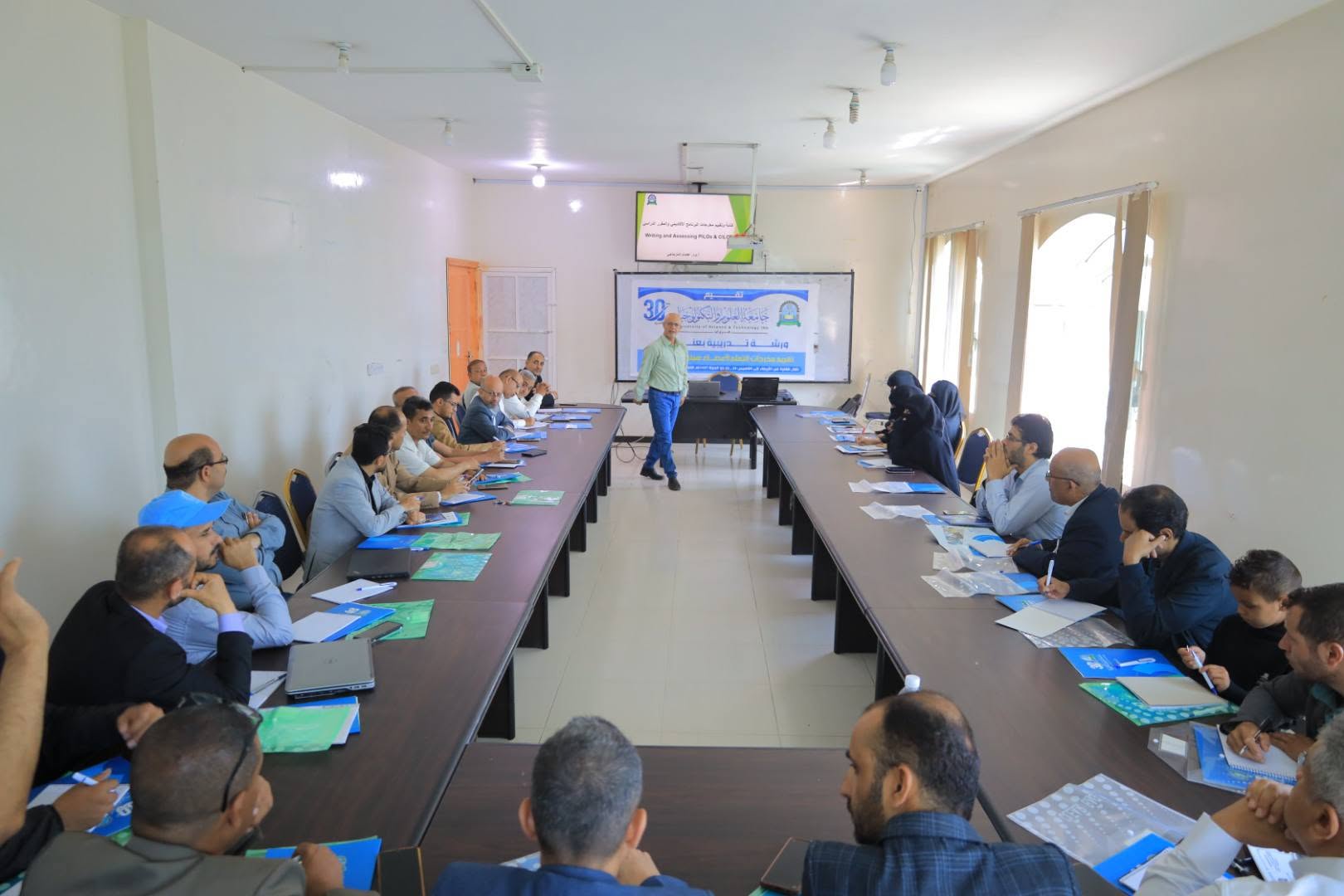
Ibb – Under the patronage of Prof. Al-Qasim Mohammed Abbas, President of the University of Science and Technology (UST), Sana’a Main Campus, the Deanship of Development and Quality Assurance organized a training workshop entitled “Academic Program and Course Learning Outcomes Assessment.” The two-day workshop targeted all faculty members at the UST Ibb Branch as part of the university’s ongoing efforts to enhance the quality of the educational process, improve academic performance, and develop assessment and evaluation mechanisms in line with academic accreditation requirements and quality assurance standards.
The workshop forms part of a series of specialized training programs implemented by the university to equip academic staff with the skills and knowledge necessary to assess learning outcomes scientifically and systematically. These efforts contribute to improving teaching quality, developing academic curricula, and enhancing students’ academic and professional achievement.
The workshop was delivered by Prof. Essam Al-Mizjaji, academic expert at UST, in the presence of Dr. Makram Al-Jamali, Director of the Ibb Branch; Dr. Badr Al-Farah, Deputy Director; heads of academic departments; Dr. Youssef Shaddad, Head of the Development and Quality Assurance Unit at the branch; and faculty members from various academic programs and disciplines.
In his opening remarks, Dr. Al-Jamali welcomed the participants and emphasized that the development and assessment of academic program and course learning outcomes represent a fundamental pillar of modern higher education. He noted that learning outcomes assessment extends beyond measuring theoretical knowledge to evaluating students’ abilities to understand, analyze, apply knowledge, and acquire the professional and ethical competencies required by the labor market and society.
He further highlighted UST’s strong commitment to quality assurance and academic development through continuous training programs aimed at enhancing faculty awareness of quality concepts and academic accreditation standards, while advancing assessment tools to ensure measurable, reviewable, and continuously improvable learning outcomes.
Dr. Al-Jamali also expressed his appreciation to Prof. Abbas for his continued support of UST branches and for sponsoring training and academic initiatives that enhance institutional and academic performance. He noted that such support reflects the university leadership’s commitment to fostering a culture of quality and excellence across all branches and colleges.
Speaking on behalf of the Development and Quality Assurance Unit, Dr. Youssef Shaddad explained that assessing program and course learning outcomes is one of the most important components of the quality assurance system. It enables academic departments to determine the extent to which program and course objectives have been achieved, identify strengths and areas for improvement, and make evidence-based decisions for continuous enhancement.
During the first day, the workshop covered several theoretical and practical topics related to writing and assessing program and course learning outcomes. Prof. Al-Mizjaji reviewed the fundamental concepts of learning outcomes and clarified the distinction between learning outcomes and general educational objectives. He explained that learning outcomes describe what students are expected to know, understand, and be able to demonstrate upon completing a course or academic program.
The workshop also addressed various categories of learning outcomes, including cognitive, intellectual, practical, professional, and value-based outcomes, as well as methods for formulating them clearly and measurably. Particular emphasis was placed on aligning learning outcomes with program missions and objectives while ensuring consistency with labor market needs and recognized academic standards.
Additionally, Prof. Al-Mizjaji discussed mechanisms for aligning course learning outcomes with program learning outcomes and highlighted the importance of developing clear curriculum mapping matrices between courses and targeted outcomes. Such alignment ensures that each course contributes effectively to the gradual and integrated development of students’ competencies. He noted that the absence of such alignment may result in unnecessary repetition of some learning areas while neglecting others, ultimately affecting the quality of academic programs and their final outcomes.
The first day concluded with an emphasis on utilizing the workshop outcomes to improve course specifications, enhance assessment and evaluation tools, and strengthen continuous monitoring and improvement processes within academic departments. These efforts aim to achieve high-quality learning outcomes and positively impact students, graduates, and academic programs across the UST Ibb Branch.