 العربية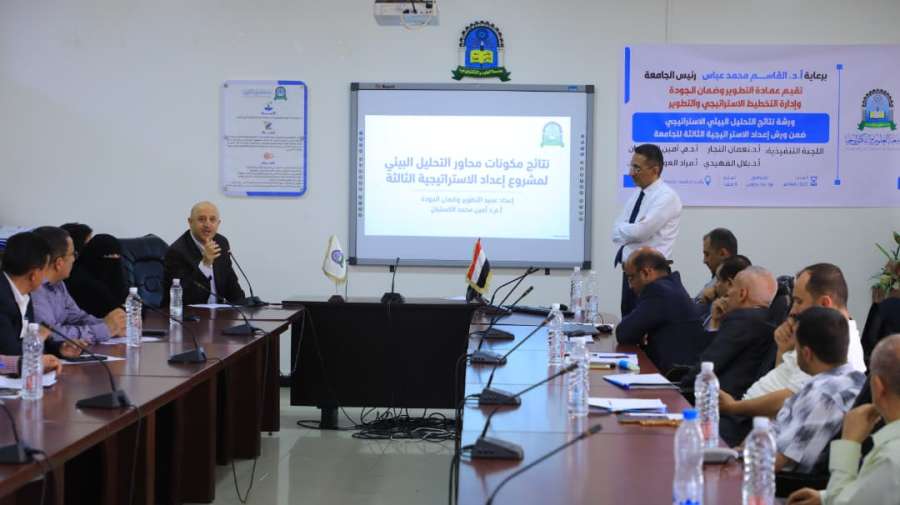
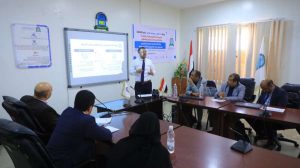
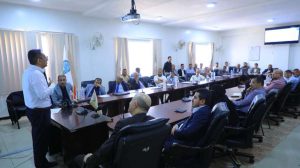
Sana’a – The Deanship of Development and Quality Assurance, in collaboration with the Strategic Planning and Development Department at the University of Science and Technology (UST), organized a workshop on Saturday, 5 Muharram 1448 AH, Corresponting to June 20, 2026, at the Seminar Hall to discuss the results of the strategic environmental analysis. This workshop forms a key phase in the development of the University’s third strategic plan, with the participation of academic and administrative leadership and members of the preparation teams.
The workshop aimed to review the outputs of the environmental analysis across its four dimensions: the internal environment, stakeholder needs and partnerships, the competitive and market environment, and the external and future environment. The goal was to identify the most impactful strategic issues and to refine the elements of the SWOT analysis, including strengths, weaknesses, opportunities, and threats.
At the outset of the workshop, Prof. Al-Qasim Mohammed Abbas, President of the University, emphasized that strategy development and implementation are collective institutional responsibilities that require the concerted efforts of all academic and administrative sectors, along with active participation from University affiliates. He stressed the importance of translating planning outcomes into actionable and measurable programs and initiatives.
He further noted that the third strategy should be grounded in a realistic understanding of both internal and external environments while anticipating future transformations in education, the labor market, and technology. He highlighted the importance of placing students at the center of the strategy by developing their skills and capabilities and enhancing their professional readiness, thereby meeting the aspirations of youth and reinforcing the University’s role in community service and development.
The University President also called for strengthening a culture of institutional work and teamwork throughout the stages of strategy preparation and implementation, as well as aligning objectives and initiatives with resources, responsibilities, and performance indicators to improve execution efficiency and ensure sustainability of outcomes.
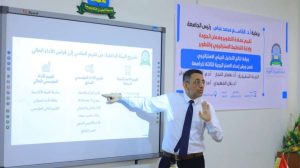
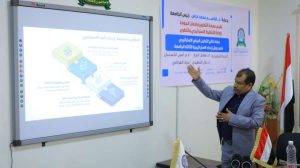
The workshop program included several specialized presentations. Mr. Murad Al-Awadhi outlined the objectives and key themes of the workshop and presented a summary of progress made in the preparation of the third strategy. Associate Prof. Amin Al-Kustaban delivered a comprehensive presentation on the results of the environmental analysis across its four dimensions.
Prof. Noaman Al-Najjar discussed the methodology for formulating strategic issues and refining SWOT elements, as well as the process of transitioning from preliminary lists to priority governing issues based on evidence strength, strategic impact, urgency, and feasibility of resolution.
Additionally, Prof. Bilal Al-Fuhaidi presented the proposed strategic issues and SWOT elements, explaining their application mechanisms, distribution among working groups, and alignment with the University’s strategic directions and dimensions.
On the practical side, participants were divided into four working groups aligned with the strategic dimensions: learning and growth, internal processes, customers and beneficiaries, and the financial dimension. These groups reviewed and prioritized the proposed strategic issues and SWOT elements to develop a focused list reflecting the most critical challenges, opportunities, and capabilities shaping the University’s future.
The workshop concluded with presentations of the working groups’ outcomes and discussions in preparation for approving the final outputs of the environmental analysis and utilizing them in formulating the University’s strategic directions, objectives, and initiatives.
This workshop represents a pivotal stage in the development of the University’s third strategy, marking the transition from diagnosis and evidence gathering to prioritization and selection. It contributes to building a realistic and forward-looking strategy that responds to stakeholder needs, aligns with evolving education and labor market trends, and strengthens the University’s leadership in education, scientific research, and community service.