
 العربية
 Business intelligence
The Business Intelligence program examines a series of processes that transform raw data into meaningful and useful information to support organizations in decision‑making, solving complex and unique problems, identifying and developing new business opportunities, planning and implementing effective strategies in production, cost management, and marketing, as well as preparing performance reports for the organization.
This specialization focuses on transforming data into smart, strategic decisions.
Key Areas of Excellence:
 Advanced data analysis projects
 Dashboard design for decision support
 Big Data analysis applications
 Analytical solutions for economic and educational institutions

Professional Partnerships – Added Strength for All Programs:
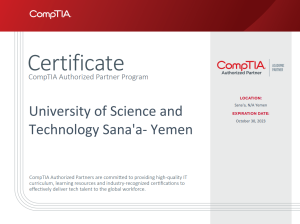
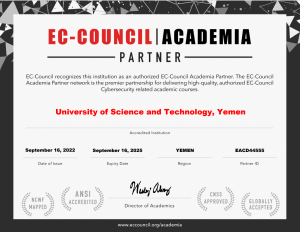
The faculty adopts an educational model that combines academic accreditation with global professional qualification through strategic partnerships with major technology leaders:
- Cisco
- Microsoft
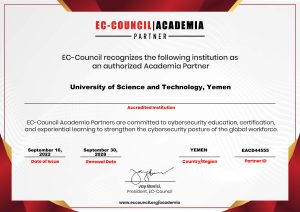
- EC-Council
- CompTIA
Global Certification Example: CCNA Certification – Alaa Abdulhamid Mohammed Algadab
What do these partnerships mean for the student?
 Integration of professional course content within the curriculum
- Hands-on training with globally recognized tools and techniques
- Qualification for obtaining international professional certifications
- Enhancing graduate readiness for the global job market
- Narrowing the gap between university education and industry needs
Marketing Value
“We prepare specialists capable of transforming data into a competitive value for organizations.”
- Equip students with valuable and in‑demand data analysis skills that enable them to become specialists in the field of Business Intelligence, regardless of the industry in which they work.
- Enable students to identify and understand the tools required for analyzing business, commercial, and applied data and information.
- Prepare students to plan, design, and build Business Intelligence and data analytics solutions, and to use essential programming skills that support working with big data.
- Refine students’ competencies in Business Intelligence and data analysis to solve real business problems by completing projects using real datasets from various domains, including information technology, finance, healthcare, public service, social care, retail, and more.
- Support students in developing databases and data warehouses, and in applying data‑mining techniques to generate predictive insights that support decision‑making. The program also aims to promote specialized research with a strong emphasis on applied aspects of Business Intelligence that have a direct impact on community development.
Upon successful completion of the program, the graduate will be able to:
A. Knowledge and Understanding
A2. Describe data warehouse architectures, analytical data models, and Online Analytical Processing (OLAP) techniques.
A3. Understand the role of Business Intelligence in enhancing organizational performance and achieving competitive advantage.
B. Cognitive / Intellectual Skills
B2. Evaluate Business Intelligence tools and techniques and select the most appropriate solutions based on organizational needs.
B3. Link analytical results to the strategic objectives of organizations.
C. Professional and Practical Skills
C2. Use Business Intelligence and data analytics tools to extract knowledge and present it visually.
C3. Develop Business Intelligence solutions that support upper and middle management in decision‑making.
D. General Skills
D2. Demonstrate commitment to professional ethics and data governance principles.
D3. Keep pace with modern developments in data analytics and Business Intelligence.
- Business Analyst
- Business Intelligence Systems Developer
- Data Warehouse Manager
- Reports Programmer and Designer
- Enterprise Resource Planning (ERP) System Manager
- Data Security and Protection Officer
- Data Visualization Manager
- Business Analytics and Big Data Trainer
- Information Technology Management Officer
- Information Systems Consultant
- Big Data Analyst
- Supply Chain Systems Officer
- Project Manager

The Bachelor’s degree is awarded to students upon completion of the following requirements:
- Successfully passing all courses required for graduation in the study plan (132 credit hours), with a minimum grade of 50% in each course.
- Completing the minimum study duration required for earning the degree and not exceeding the maximum number of years allowed, in accordance with the academic regulations of the credit‑hour system.
- Transfer students must complete no less than 50% of the total credit hours required for graduation according to the approved study plan at the time of admission, in accordance with the regulations of the Ministry of Education and Higher Education.
- Completion of field training requirements.
- Completion of the graduation project requirements.
- Maintaining an attendance rate of no less than 75%.
The cognitive skills acquired by students throughout their years of study in the program are distributed across the following domains:
- Knowledge and understanding skills in various areas of the specialization, such as the fundamentals of Information Systems and related fields.
- Intellectual skills, including analysis, design, and other higher‑order thinking abilities.
- Practical and applied skills, demonstrated through the effective use of various software tools, proficiency in multiple programming languages, and the development of specialized information systems.
- Transferable skills, such as effective language use, writing and presenting various projects and documents, and other essential communication abilities.
- Data Analysis and Decision‑Making
- Dashboards and Data Visualization
- Enterprise Business Intelligence
- Big Data Analytics
- Strategic Decision Support
- Business Intelligence Analyst
- Data Analyst
- Data Warehouse Developer
- Reporting & Dashboard Developer
- Decision Support Systems Analyst
- Data‑Driven Business Analyst
- Organizational Performance Analysis Specialist
- Data Integration Specialist
- Business Intelligence Specialist in public and private sectors
- Junior Researcher in Data Analytics and Business Intelligence
- Big Data Analyst
- Supply Chain Systems Officer
- Project Manager
Views: 79