

 العربية
 Medicine and Surgery Program
The Bachelor of Medicine and Bachelor of Surgery (MBBS) program is regarded as one of the fundamental pillars upon which the University of Science and Technology (UST) was established in 1994, pursuant to the decision of the Ministry of Higher Education and Scientific Research No. (2/94). In its early years, the program was offered under the College of Medical Sciences, which also encompassed the Dentistry and Pharmacy programs. In 2011, a university decision was issued to separate these programs into independent colleges, leading to the establishment of the College of Medicine and Health Sciences, which has hosted the program ever since.
The experience of the University of Science and Technology (UST) in Yemen—particularly through its Bachelor of Medicine and Bachelor of Surgery (MBBS) program—represents a landmark in the history of medical higher education in the southern Arabian Peninsula and the Middle East. Studying this program requires an in-depth exploration of the academic and institutional transformations witnessed by Yemen since the mid‑1990s, a period marked by an urgent need to break the monopoly of public education and to establish private educational models capable of keeping pace with the rapid global advancement in medical sciences. This report provides a rigorous academic analysis of the historical trajectories, educational philosophies, and the ecosystem of achievements that have positioned the program as a significant force in regional and international medical training.
Strategic significance: The launch of the first private medical department in Yemen as part of the College of Medical Sciences.
Strategic significance: The transformation of the college into an independent entity with a focused mandate on human medicine and health sciences.
Strategic significance: The initiation of integrated curricula, alongside comprehensive modernization of laboratories and educational facilities.
Strategic significance: Sustained efforts to obtain recognition from the World Federation for Medical Education (WFME).
To graduate distinguished physicians who are capable of self-directed learning and continuous professional development, and who provide healthcare that meets the needs of the community at the local, regional, and global levels. Graduates are committed to professional ethics through a stimulating educational and research environment and effective partnerships that contribute to enhancing community health.
- To supply society with physicians who are scientifically, research‑oriented, and professionally competent, committed to medical ethics and global health standards.
- To advance education and scientific research and effectively employ them to meet healthcare needs at the local and regional levels.
- To promote community health through effective cooperation and strategic partnerships with relevant stakeholders.
- To activate self‑directed learning and continuous professional development in support of strengthening the healthcare system locally and regionally.
Upon completion of the program, graduates are expected to be able to demonstrate the following learning outcomes:
Knowledge and Understanding
A2 Recognize the stages of human development across all phases of growth, including changes in structure and function during these stages, and identify indications for appropriate intervention, including diagnosis and management of various conditions.
A3 Explain pathological changes in different diseases, their mechanisms, and precipitating causes, including genetic, developmental, infectious, metabolic, endocrine, autoimmune, traumatic, degenerative, behavioral, social, environmental, and occupational factors.
A4 Identify local and global evidence related to disease management and prevention, as well as risk factors affecting community health.
A5 Recognize the theories and principles governing ethical issues, decision‑making, and the medical and legal aspects of medical practice.
Cognitive / Intellectual Skills
B2 Analyze and interpret findings derived from medical history, clinical examination, and investigations in order to diagnose diseases and develop management plans, including acute and chronic physical and mental emergencies.
B3 Discuss knowledge and approaches related to global and community health, health promotion, and healthcare delivery.
Professional and Practical Skills
C2 Develop appropriate management plans for patients, including prescribing suitable medications while considering benefits, side effects, interactions, safety, and availability.
C3 Perform routine medical procedures and demonstrate the ability to use essential medical instruments required for diagnosis and treatment, applying evidence‑based practice, ensuring patient safety, and considering the cost of care.
C4 Provide promotive and preventive care, health education, and counseling to patients, their relatives, and the community.
C5 Write a research proposal, conduct a supervised descriptive research study, and present data.
C6 Recognize personal and professional limitations and seek assistance from colleagues and supervisors when necessary.
C7 Respect patients’ rights, cultural beliefs, values, and privacy; involve patients in decision‑making; and treat all patients equally regardless of their beliefs, culture, or behaviors.
General and Transferable Skills
D2 Work independently, as part of a team, and as a leader, and pursue lifelong learning using up‑to‑date technologies and resources that support disease management.
D3 Respect cultural, ethical, and personal beliefs, privacy, and diverse values of patients and the community, while demonstrating professional conduct and adherence to institutional and national regulations governing medical practice.
- Healthcare Provider: Deliver high‑quality, patient‑centered care that is efficient, effective, and safe, within the defined scope and limits of one’s expertise and within the context of the healthcare system.
-
Professional: Adhere to ethical, professional, and legal standards; demonstrate commitment to patients, the profession, and society; and maintain personal safety while pursuing lifelong personal and professional development.
-
Researcher: Utilize medical knowledge and health research to meet the needs of patients, the healthcare system, and the community.
-
Health Advocate: Contribute to disease prevention and the promotion of health and well‑being for patients and the wider community.
-
Communicator and Collaborator: Communicate effectively with patients, their families, healthcare teams, and the community; engage in interprofessional collaboration; and function both as a team member and a leader.
The Bachelor’s degree is awarded to students upon fulfilling the following requirements and conditions:
-
Study Plan: Successful completion of all academic courses required for graduation in accordance with the approved study plan.
-
Time Frame: Completion of the minimum period required to obtain the degree, provided that the student does not exceed the maximum number of years for graduation as stipulated in the applicable academic regulations.
-
Transfer Students: For students transferring to the University, it is required that they successfully complete no less than 50% of the total number of credit hours required for graduation, in accordance with the study plan approved at the time of their admission to the University.
The program adopts an Integrated System approach, which focuses on studying body organs as interconnected systems. The knowledge domains include:
-
Basic Medical Sciences: Including Anatomy, Physiology, Biochemistry, and Pharmacology.
-
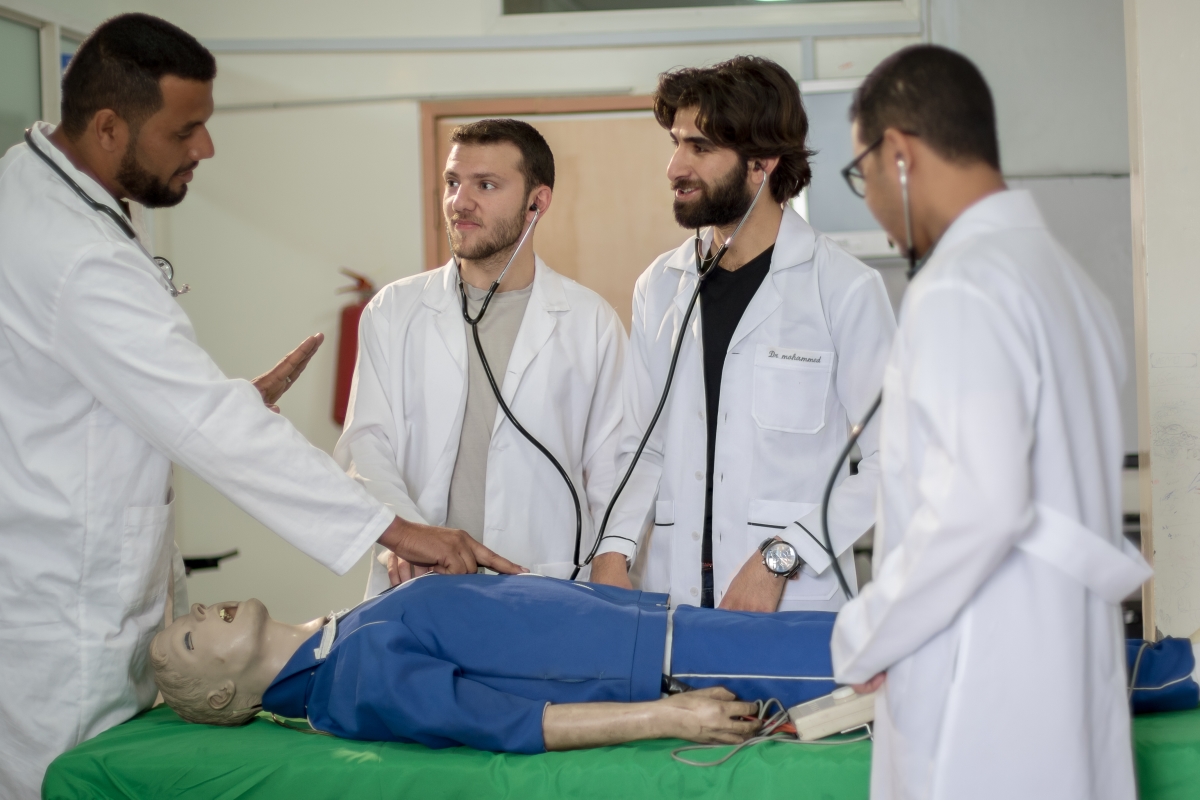
Clinical Sciences: Field-based clinical training in Internal Medicine, General Surgery, Pediatrics, and Obstetrics and Gynecology.
-
Problem-Based Learning (PBL): Developing critical thinking and clinical diagnostic skills through realistic case-based scenarios.
-
Scientific Research and Professional Ethics: Acquiring competencies in conducting medical research and adhering to professional ethical standards.
-
Community Medicine: Emphasizing primary health care and disease prevention within the local community context.
Career Opportunities:
- Hospitals and Clinics: Employment as a General Practitioner (GP) in public and private hospitals.
- Primary Health Care Centers: Managing and delivering health services in urban and rural health centers and clinics.
- Military Medicine: Joining medical services within the armed forces or security institutions.
- University Teaching: Working as a Teaching Assistant in medical colleges (subject to meeting academic excellence requirements).
- Research Centers: Contributing to epidemiological and clinical studies aimed at developing and improving treatment protocols.
- World Health Organization (WHO) and UNICEF: Working in programs related to epidemic control, immunization, and health education.
- Humanitarian Organizations: Providing medical support in conflict zones or during emergencies and disasters.
- Health Administration: Holding administrative positions in health institutions or within the Ministry of Public Health.
- Pharmaceutical Companies: Working as a Medical Advisor or Scientific Representative for major pharmaceutical companies.
The program extends over six academic years, followed by a mandatory internship year, during which the student undergoes intensive practical training prior to obtaining a professional practice license.
Scientific research
- Basic and applied medical research
- Public health and community health studies
- Disease prevention, diagnosis, and treatment research
- Epidemiological and health surveys
- Health impact assessment of medical interventions
- Research addressing priority health challenges
- Medical education and healthcare quality improvement
- Interdisciplinary research in medical and health sciences
- Specialized medical laboratories and advanced modern equipment.
- A modern scientific and digital library serving the needs of scientific research.
- A Research Consultancy Center staffed with qualified professionals providing support across various aspects of scientific research, research methodologies, and statistical analysis.
- A Tropical Diseases Research Center.
6th-Year Medicine and Surgery Graduation Research Projects
| No. | Research Title | Abstract | Supervised By | Done By |
|---|---|---|---|---|
| 1 | Knowledge, Attitude, and Practice of Blood Donation Among Male Students of University of Science and Technology, Sana’a, Yemen, 2026 | Assessment of knowledge, attitude, and practice regarding blood donation among undergraduate UST students. | Dr. Abdullah Almikhlafy | Abdulraheem Yahya, Abdullah Badr, Abdul Qader Al-Attas, Ammar Al-Ahdal, Marwan Qhazi, Taha Jafar |
| 2 | Prevalence of Myopia and Its Associated Risk Factors Among Male Medical Students at University of Science and Technology, Sana’a, Yemen, 2025-2026 | Study on the prevalence of myopia and risk factors among male medical students during the 2025–2026 academic year. | Dr. Abdullah Almikhlafy, Dr. Tariq Al-Doais | Ahmed Alkeldi, Basel Al-Masuodi, Ibrahim Al-Sanabani, Mohammed Al-duhaidh, Muhannad Ali Wali |
| 3 | Knowledge, Attitude and Practice Towards First Aid among School Teachers in Sana’a, Yemen, 2025-2026 | Assessment of the level of knowledge, attitudes, and practices towards first aid among school teachers in Sana'a. | Dr. Dua’a Jamal Mutaher | Asma'a Altobaiey, Bothaynah AL-kassos, Entesar Al-Jumaei, Marwa Fateni, Omaymah AL-kassos, Rayyan Ali Nadesh |
| 4 | Hospital Base Cross Sectional Study of Traditional Medical and Daily Care Practice and Attitude Among Pediatric Caregiver in Tertiary Hospitals in Sana’a, Yemen (2025-2026) | Assessment of traditional medical practices, attitudes, and sociodemographic factors among pediatric caregivers. | Dr. Mahdi Al-Qarawani, Dr. Ahmed Hudna, Dr. Ahlam Abdulmalik | Ashwaq Abualrejal, Hajer Hassan Alezi, Maria Alfakih, Roa’a aljabwobi |
| 5 | Knowledge About Congenital Infections (Torch) Among Women in Sanaa Hospitals, Yemen, 2025. | Assessment of knowledge regarding TORCH infections among women of reproductive age. | Dr. Mahdi Al-Qarawani, Dr. Mona ALnamer | Amat-Alsalam Bassam, Safwa Al-Qudaimi, Shaima Alhadha, Alia Alaqel |
| 6 | Prevalence of Cataract and Its Associated Risk Factors Among Ophthalmology Clinics Visitors Age More Than 40 Years Old Sana’a, Yemen, 2025 – Hospital Based Study | Prevalence and risk factors of cataracts among ophthalmology clinic visitors over 40 years of age. | Dr. Mahdi Saad Al-Karawani, Dr. Ibtisam Noman Al-Towaity | Siham Al-Gharasi, Aisha Al-Gharasi, Nada Salah Aldeen, Shaima Sanhoop |
| 7 | Prevalence And Risk Factors of Strabismus Among University of Science and Technology Female Medical Students, Sana’a, 2025 | Assessment of the prevalence and associated risk factors of Strabismus (squint). | Dr. Mahdi Alqarawani, Dr. Tariek Aldoais | Reem Abdo Mohamed, Khadija Al-Lail, Eman Abdo Nasr, Hebah Al-halaki, Yomna Yahya Enash |
| 8 | Knowledge, Attitude, and Willingness Toward Kidney Donation Among Medical Students at University of Science and Technology in Comparison with General Population in Sana’a, Yemen 2025-2026 | Assessing and comparing kidney donation perspectives between medical students and the general population. | Dr. Mahdi Al-Qarawani | Mohammed Al Jarfi, Abdulhakim Amer, Anas Al-Othigi, Abdullah Al Wasabi |
| 9 | Postoperative Complications of Appendectomy among Patients in Sana’a, Yemen, 2025. | Outcomes and postoperative complications following appendectomy procedures. | Dr. Mahdi Al-Qarawani, Dr. Walid Ghailan | Mohammed Al-Najjar, Mohammed Al-Ariqi, Safwan Ali, Mohammed Al-Mikhlafy, Mousa Al-Aghbas, Abdulmajeed Al-Jaeedi |
| 10 | Awareness and Knowledge of Glaucoma and it’s Risk Factors among Visitors of Main Hospitals in Sanaa City, Yemen, 2025-2026. | Evaluating awareness and knowledge levels regarding glaucoma among hospital attendees. | Dr. Mahdi Saad, Dr. Abdulmogni Albarrage, Dr. Esmail Hajar | Alaa Abdulkader, Alaa Khalid Ali, Afnan Ali, Bushra Abdulkareem, Eradah Alazzani, Somaia Abdu Alnaser |
| 11 | Parents’ Knowledge, Attitudes, and Practices toward Rheumatic Fever and Rheumatic Heart Disease in Sana’a City, Yemen, 2025. | Evaluating parental KAP regarding prevention and early management of Rheumatic Fever/Heart Disease. | Dr. Duaa Mutahar | Nada Waheeb, Wejdan Al-awadi, Wedad Al-awadi, Hadeel Alsabri, Yusra Noaman |
| 12 | Level of Knowledge Regarding Amblyopia: Implications for Prevention and Early Detection among Undergraduate Students at the University of Science and Technology, Sana’a, Yemen, 2026. | Assessing student knowledge regarding amblyopia (lazy eye) prevention and detection. | Dr. Dua’a Mutahar | Amr Al-Aghbari, Ayman Al-Ahmadi, Taha Khalil Ghazi, Anas Al-Dhaferi, Rafiq Al-Ghariri |
| 13 | Prevalence of suspected Systemic Lupus Erythematosus Related Symptoms among Patients Attending in selected Hospitals in Sana’a City, Yemen, 2025-2026. | Study to determine the prevalence of suspected symptoms related to SLE. | Dr. Dua’a Mutahar | Abeer Juzilan, Amani Juzilan, Afnan Al-barae, Amna Al-shaibah, Randa Al-qadi |
| 14 | Knowledge, attitude, and perception of cesarean section among pregnant women attending Teaching Hospitals in Sana’a City, Yemen 2025 | Assessing maternal knowledge, attitudes, and perception toward cesarean section procedures. | Dr. Abdullah Al-Mikhlafy, Dr. Maha AbdulAziz | Ala’a Aljawmari, Manal Gamal, Najat Marawh, Zainab Hasan Abbas, Amani Ali Alaswadi, Gihan Saleh Gaashan |
| 15 | Assessing the Knowledge, Attitude and Prescription Practice of Physicians in selected Hospitals Toward Probiotics in Sana’a City, Yemen, 2025 | Study on physicians' knowledge, attitude, and clinical practice regarding probiotic use. | Dr. Duaa Mutahar | Alzahraa Aldhabyani, Alzahra Saleh Shaban, Raghd Dhabaan, Reem Altahish, Sarah Al-rabea, Shahd Alrobioy |
| 16 | Knowledge, Attitudes and Practices Regarding Antibiotics Resistance Among Male Medical and non-Medical Students at University of Science and Technology, Sana’a, Yemen, 2025. | Assessment of student KAP regarding antibiotic resistance. | Dr. Duaa Mutahar | Basheer Nasser, Ali Mujammel, Abdulrahman Aldolei, Feras Ali Al Harbi, Mohammed Al-Mubarzi, Waleed Ahmed Hajj |
| 17 | Risk Factor of Gastric Cancer Among Patients Attending the National Oncology Center in Sana’a Yemen: A Case Control Study, 2025 | Identification of risk factors associated with gastric cancer. | Dr. Mahdi Al-Qarawani | Mohamed Alobaidi, Osama Al Edany, Fadhl Ali Al-Sharsi, Yunes Saleh Al-Azizi, Ahmed Abdullah Qaid, Osamah Ahmed Farhan |
| 18 | Nurse’s Knowledge, Attitude, and Practice Toward Pressure Ulcer Prevention at the University of Science and Technology Hospital and Al-Gumhori Hospital, Sana’a, Yemen, 2025. | Assessment of nurse KAP regarding pressure ulcer prevention. | Dr. Duaa Mutahar | Hashem Al-Salahi, Malek Fayz Harhara, Taha Khalid Saadan, Hassan Al-Ahdal, Honain Mansour Zubair, Hudaifa Al-Humaidi |
| 19 | Association between Beliefs about Medication and Medication Adherence among Patients with Chronic Diseases: A Cross-Sectional Study in Sana’a, Yemen, 2025-2026 | Evaluating medication adherence and the influence of patient beliefs about medicine. | Dr. Mahdi Saad Al-Qarawani | Samah Al-Nono, Dina Alnagmy, Eshtyauq Abdo Al-bajli, Ayat Hani Aldobai, Lamess Alobaidi |
| 20 | Analysis of Oncology Medical Staff’s Knowledge, Attitudes, Practices, and Barriers towards Palliative Care in Sana’a, Yemen, 2025 – 2026. | Analyzing oncologist KAP and barriers to providing palliative care. | Dr. Mahdi Al-Karawani | Khaled Abdo Badr, Taha Ahmed Qasem, Ahmed Al-Arassi, Suhail Moqbel Al-Haj, Akram Yahya Al-Wadei |
| 21 | Prevalence and Associated Factors of Burnout among Medical and Dental Students at University of Science and Technology, Sana’a, Yemen, 2024. | Prevalence study and factor analysis of burnout among medical/dental students. | Dr. Abdullah Al-Mikhlafy, Dr. Waleed Ghailan | Ameer Dhalnon Mohammed, Ahmed Nasser Habtoor, Ahmed Al-Arashi, Islam Adel Al-Humi, Ibraheem Al Qadasi, Mohammed Al-Saadi |
| 23 | The Rate of Axillary Lymph Nodes Metastasis in Breast Cancer after Axillary Lymph Nodes Dissection Among Breast Cancer Patients, Sana’a, Yemen, 2025. | Determination of the rate of axillary lymph node metastasis in patients with breast cancer. | Dr. Mahdi Sa'ad Al-Qarawani, Dr. Labeeb Abdullah Alaghbari | Aya Alhammady, Ruba Abdullah, Shaima Ali Alnaqeb, Suuad Alsaqqaf, Norah Aqel Albari |
| 24 | Knowledge, Attitude, Practice and Usage Pattern of Analgesics Among Analgesics Users Male Students of University of Science and Technology Sana’a, Yemen, 2025 | Evaluation of analgesic use patterns and KAP among students. | Dr. Abdullah Al-Mikhlafy | Abdulmajeed Abdullah, Abdullah Al_Ahdal, Mohammed Ahmed, Mohammed Maasher, Mohammed Al_Saqqaf |
| 25 | Prevalence and Associated Factors of Burnout among Medical and Dental Students at University of Science and Technology, Sana’a, Yemen, 2024. | Prevalence and factors linked to student burnout syndrome. | Dr. Abdullah Abdu Al-Mikhlafy | Walaa Ahmed Al-Gweid, Lool Gamil Al-Akhali, Maha Abdulmunam, Ghalih Abdulrzak, Ghalih Ali-Al Thabty |
| 26 | Knowledge and Practice of Mothers Regarding Nutritional Rickets among Children at the University of Science and Technology Hospital, Sana’a, Yemen, 2024. | Assessing maternal awareness and practical care regarding nutritional rickets. | Dr. Abdullah Abdu Al-Mikhlafy | Abrar Abdullah Ghanem, Reham Al-Arefi, Hanin Khalid Haider, Hiam Ali Al-Bohan, Baraka Al-Dubai |
| 27 | Knowledge, Attitudes and Opinions Towards Patient’s Safety among Clinical Medical Students and General practitioners of Faculty of Medicine and Health Sciences at University and Hospital of Science and Technology, Yemen, Sana’a, 2025. | Measuring knowledge/attitudes on patient safety standards. | Dr. Essam Al-Safadi | Ansam Naji Ali, Eman Abdulwahab Ali, Hiba Tawfik Saeed, Saleha Faraj, Shaimaa Omar, Haya Malek Hussain |
| 28 | Knowledge and Practice of Mothers Regarding Nutritional Rickets among Children at the University of Science and Technology Hospital, Sana’a, Yemen, 2024. | Assessing parental knowledge concerning pediatric nutritional rickets. | Dr. Mahdi Sa’ad Al-Qarawani, Dr. Anwar Hamood Yusr | Ahd Hamoud Haider, Arzaq Al-Awadhy, Amra Adel Al-Yemeni, Tahani Al-Riashi, Omaima Talal Al-Saidi |
| 30 | Prevalence of Myocardial Infarction Morbidity and Mortality Among Patients and Their Management Protocols at University of Sciences and Technology Hospital in Sana’a, Yemen, 2024 | Study on the morbidity and mortality rates associated with Myocardial Infarction. | Dr. Essam Hamdi Alsafadi | Azhar Waheeb, Khlood Khaled Al-Hayal, Malak Al-Dheleia, Manal Khaled, Omeima Al-Ghili |
| 31 | The Quality of life among Yemeni Women Using Intrauterine Device and Oral Contraceptive Attending Selected Primary Health care centres, Sana’a, Yemen, 2024. | Analyzing QOL impacts of IUDs vs Oral Contraceptives. | Dr. Duaa Mutahar | Afaf Abdullah Mahdi, Fatima Jalal Al-Refaci, Hajar Ahmed Abdullah, Maleka Mohammed, Tarteel Mohammed, Wafaa Saud Al Awar |
| 32 | Knowledge and Attitude Regarding the Premarital Screening among Medical and Health Sciences Female Students, University of Sciences and Technology, Sana’a, Yemen, 2024/1445. | Knowledge and attitude regarding Premarital Screening (PMS). | Dr. Essam Hamdi Al-Safad | Mayada Abu-Alrejal, Ola Waheed Abdullah, Milyar Ali Al-Jabha, Shroq Khaled Al-Murisi, Thekra Al-Wajeehi |
| 33 | Prevalence of Fast-Food Consumption, Overweight and Obesity among Female Students at University of Science and Technology, Sana’a, Yemen, 2023-2024. | Association between fast food habits and body composition (BMI). | Dr. Mahdi Saad Alqarawni | Abeer Alharony, Azhar Nasser, Sawsan Mohammed, Siham Ahmed |
| 34 | Frequency and Clinical Features of Guillain Barré Syndrome Among Patients of University of Science and Technology Hospital from 2014 to 2023, Sana’a, Yemen, 2023 | Analyzing clinical data for patients diagnosed with Guillain Barré Syndrome. | Dr. Mahdi Al-Qarawani, Dr. Adeeb Salah | Eissa Sadeq Al-Fotaihi, Rasheed Dares Murait, Osama Fhami Waza’a, Amgad Al-Haddad, Khalid Muthanna, Bassam Ali Al-Zedar |
| 35 | Prevalence And Causes of Absenteeism Among Undergraduate Female Medical Students and Health Science University of Science and Technology Sana’a, Yemen, 2024 | Prevalence and underlying causes of student absenteeism. | Dr. Mahdi Saad Al-Qarwani | Ansam Mohammad, Ranu Fadhl Hakami, Sahar Sultan Alkholidy, Liza Alsamaie, Rawan Alshurafi, Sumaya Alboashy |
| 36 | Prevalence Of Antibiotic Profile Among Patient In Selective Major Hospitals Sana’a, Yemen 2023 | Antibiotic profile study in selective hospitals. | Dr. Mahdi Saad, Dr. Adeeb Salah | Ala’a Hasan Aljanadi, Doa’a Fouad Alqbaty, Fatima Abdu Zayed, Halah Waheed Alsaby, Hassena Almogany |
| 37 | Knowledge, Attitude and Practice of Computer Vision Syndrome among Medical Students in University of Science and Technology, Sana’a, Yemen, 2024. | Assessing student KAP regarding symptoms of computer vision syndrome. | Dr. Mahdi Saad Al-Qarawani | Rania Ali Haider, Marwh Thabet Al Ahdal, Malak Murad Al-Areqi, Weam Al Sobaihi, Yasmin Al-Shadady |
| 39 | Prevalence, Risk Factors and Prognosis of Cerebrovascular Accident and its Subtypes Among Admitted Patients in University of Science and Technology Hospital Sana’a, Yemen, 2022-2023 | Evaluation of CVA prevalence and associated prognostic factors. | Dr. Mahdi Saad Al Qarwani | Amr Shuaib Sa’adan, Mohammed Abbas Muharram, Salah Yahya Ahmed, Ammar Mohammed Dhemesh, Daifallah Taher Ali |
| 40 | Prevalence Of Gastro-Esophageal Reflux Disease and Its Associated Risk Factors Among Medical Students in Sana’a 2023-2024. | Prevalence and factors for GERD among students. | Dr. Abdulkhaliq Obadi, Dr. Mahdi AL-Qarwani | Al-Hasan Al-atas, Abdulbaset Al-Mekhlafi, Omer Al-Saqiya, Ebrahim Alsaidi, Zakria Rajeh, Huthefa Fara’a, Ezzedine Ahmed |
| 41 | Prevalence and Effects of Smartphone Addiction on Sleep Quality and Academic Performance among Male Medical Students at University of Science and Technology, Sana’a, Yemen, 2024 | Study on the link between phone addiction, sleep quality, and academic outcome. | Dr. Mahdi Al-Qarawani | Ali Mohammed Amer, Abdullah Hassan Badda, Yosef Hassan Badda, Abdulmajeed Abdullah, Mohammed Fouad |
| 42 | Frequency and Clinical Features of Guillain Barré Syndrome Among Patients of University of Science and Technology Hospital from 2014 to 2023, Sana’a, Yemen, 2023 | Clinical analysis of GBS cases at USTH (2014-2023). | Dr. Mahdi Al-Qarawani, Dr. Adeeb Salah | Eissa Al-Fotahi, Rasheed Dares Murait, Osama Fhami Waza’a, Amgad Al-Haddad, Khalid Muthanna, Bassam Ali Al-Zedar |
| 43 | Prevalence and Associated Factors of Absenteeism Among Male Under Graduates Medical Students at University of Science And Technology, Yemen, Sana’a, 2024. | Prevalence study regarding male medical student absenteeism. | Dr. Mahdi Al-Qarwani, Dr. Adeeb Salah | Nawaf Alkharraz, Abdulbaset Alazie, Bashar Musaed Alward, Basheer Mohammed, Hamza Albadaini |
| No. | Year | Research Title & DOI Link | Author(s) | Journal / Publisher | Scopus/WoS | Scientific Field |
|---|