
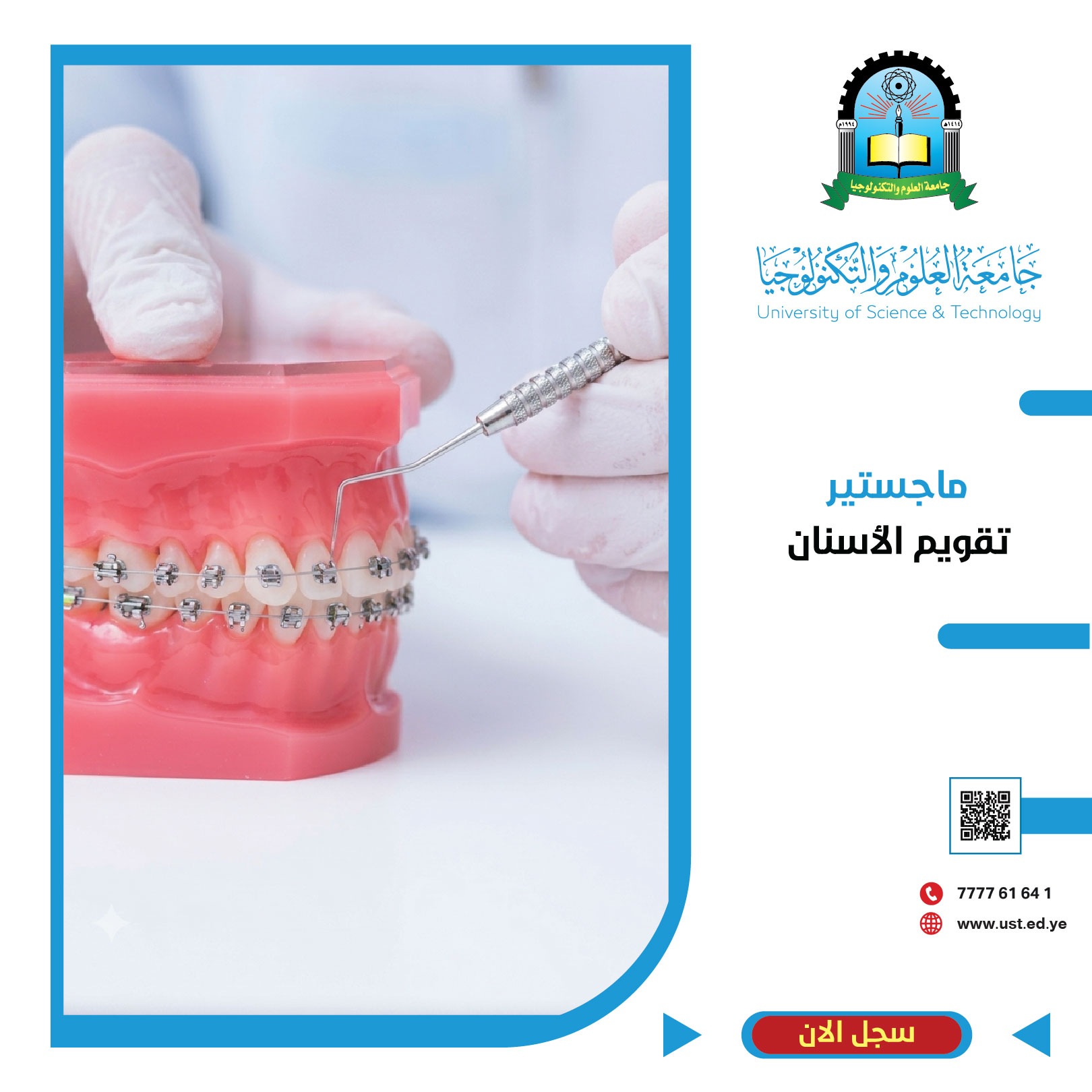
Master's Program in Orthodontics

The College of Dentistry at the University of Science and Technology (UST) offers a Master’s Program in Orthodontics, designed to build upon students’ undergraduate education. The program was initially launched in collaboration with the Faculty of Dentistry at Tanta University in Egypt during the period from 2008 to 2012, during which two cohorts graduated, comprising approximately 30 students from various dental specialties. The College of Dentistry subsequently continued to develop the program independently, resulting in the graduation of two additional cohorts, with around 40 students from different dental specialties.

The program aims to enhance students’ critical thinking and research skills, improve oral healthcare outcomes, and address community-related dental health challenges. The program has now been formally designated as a single specialized discipline in Orthodontics.
The program traces its roots to the field of dental sciences in 2014. In light of its growing success, it was established as an independent program in 2021. The program has contributed to supplying dental clinics with 24 distinguished consultants specializing in orthodontics.
The Master’s Program in Clinical Dentistry / Orthodontics aims to develop students’ academic and research competencies and to enhance the quality of community dental healthcare services.
The Master’s Program in Clinical Dentistry / Orthodontics aims to:
  1. Revitalize and enhance students’ knowledge of the fundamental sciences essential to the clinical practice of dentistry and relevant to all aspects of orthodontics.
  2. Acquire advanced clinical knowledge and skills in orthodontics.
  3. Learn how to manage patients presenting with advanced stages of malocclusion.
  4. Develop research skills in terms of study design, implementation, evaluation, and the preparation of reports on research findings.

A. Knowledge and Understanding

The student will be able to:
A.1 Describe the scientific and biological foundations of orthodontics, as well as the relevant biomedical and behavioral sciences that constitute the basis for understanding craniofacial growth and development.
A.2 Explain the structure and function of craniofacial components in health and disease in relation to the practice of orthodontics.
A.3 Identify the rules and ethical principles governing orthodontic practices and procedures.
A.4 Describe the specialized clinical, laboratory, and diagnostic procedures applied in orthodontics.
A.5 Demonstrate an understanding of the psychological, cultural, and social factors that influence the prevention and treatment of malocclusion.
A.6 Explain the principles of evidence-based orthodontics and their relationship to scientific research.
B. Intellectual Skills
The student will be able to:
B.1 Integrate theoretical biomedical, behavioral, and basic dental sciences with clinical signs and symptoms to properly understand and manage malocclusion.
B.2 Apply critical thinking and evidence-based problem-solving when delivering patient care.
B.3 Prioritize patients’ treatment needs and develop appropriate orthodontic treatment plans.
B.4 Develop preventive strategies at different levels according to the needs of individuals and targeted communities.
B.5 Select appropriate dental and orthodontic materials and prescribe the necessary medications for each clinical case.
C. Professional and Practical Skills
The student will be able to:
C.1 Obtain and record a comprehensive medical and dental history, perform appropriate clinical examinations, and conduct relevant investigations to reach accurate diagnosis and treatment.
C.2 Detect pathological conditions related to the practice of orthodontics.
C.3 Apply infection control measures and radiation protection in accordance with international standards.
C.4 Implement preventive measures for different age groups, taking into consideration the varying needs of young children, adolescents, adults, individuals with special needs, and the elderly.
C.5 Plan the timing, method, and destination of patient referral to specialists based on clinical assessment.
C.6 Assess the risks of medical emergencies and manage them efficiently within the dental clinic environment.
C.7 Apply comprehensive clinical orthodontic practices.
D. General Skills
The student will be able to:
D.1 Commit to continuing education, self-development, and lifelong learning to keep pace with the latest advances in orthodontics.
D.2 Utilize advanced information and communication technologies to enrich and diversify professional experience.
D.3 Demonstrate leadership and teamwork skills with colleagues and other oral healthcare team members to deliver effective oral healthcare services.
D.4 Manage time effectively, prioritize treatment, and work within defined timeframes.
D.5 Maintain complete and accurate clinical records, both manual and electronic.

Upon completion of the program, the graduate will be characterized by the following attributes:

  • Clinical Competence: Possession of the necessary skills to diagnose and deliver orthodontic treatment in its various forms with a high level of efficiency and professionalism.
  • Critical Thinking and Problem-Solving: The ability to analyze complex clinical cases and develop innovative and appropriate treatment plans.
  • Professionalism and Ethics: Commitment to the application of professional ethical principles in dealing with patients and safeguarding the confidentiality of their information.
  • Communication and Teamwork Skills: The ability to establish effective relationships with patients and colleagues and to collaborate efficiently within a multidisciplinary healthcare team.
  • Research Capability and Lifelong Learning: Dedication to continuous professional development, keeping pace with the latest scientific and technological advancements, and active participation in high-quality research within the field.
Degree Award Requirements:

  1. Successful completion of all courses included in the approved study plan.
  2. Successful defense of the Master’s thesis.
  3. Submission of the required bound copies of the research thesis.
  4. Passing the English language proficiency examination.
  5. Completion of all degree-awarding procedures through the Graduate Studies Committee, the Graduate Studies Council, and the University Council.
  • Specialized orthodontic courses.
  • Core dentistry courses.
  • Scientific research methods and statistics courses.

Fields and Career Opportunities Available to Program Graduates

Clinics, Hospitals, and Specialized Centers
  • Practice as a Specialist Dentist: Graduates acquire advanced competencies that enable them to establish their own private practice or work in private dental clinics and centers as orthodontic specialists.
  • Specialized Clinics: Employment opportunities are available in major medical centers and in public and private hospitals that provide orthodontic services.
Academic and Research Sector
  • University Education: Graduates may pursue academic careers as faculty members in colleges of dentistry, teaching specialized orthodontic courses.
  • Scientific Research: Opportunities to engage in specialized research centers focused on the development of orthodontic techniques and materials.
Medical Industries
  • Manufacturing Companies: Graduates may work as consultants or scientific supervisors in companies specializing in the manufacture of dental and orthodontic materials and devices, leveraging their in-depth knowledge of the latest technologies and materials.

Views: 76