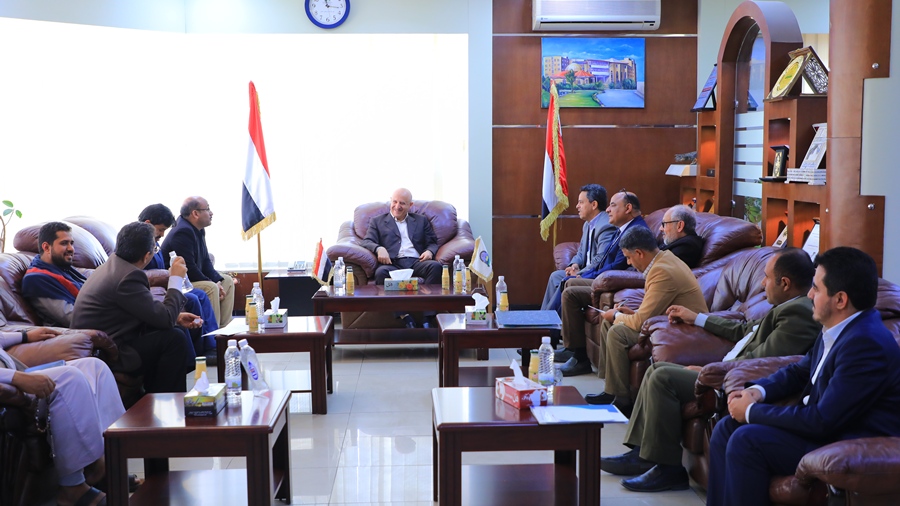
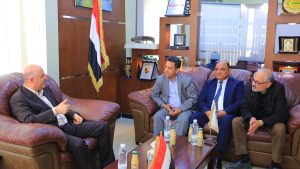
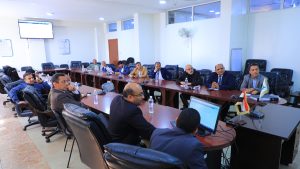
The delegation was welcomed by UST President Prof. Al‑Qassem Mohammed Abbas, Vice President Prof. Nu’man Al‑Najjar, Dean of Development and Quality Assurance Prof. Amin Mohammed Al‑Kustaban, Dean of the Faculty of Computing and Information Technology Prof. Bilal Abdullah Al‑Fahidi, University Secretary‑General Dr. Fouad Hanish, along with several academic and administrative leaders from across the university.
During the meeting, Prof. Al‑Qassem Abbas emphasized that UST is distinguished by its highly qualified, full‑time academic staff—an advantage not commonly found in other private universities. He also highlighted the university’s comprehensive infrastructure and advanced technological systems, noting that UST has made substantial strides in institutional development, quality assurance, and academic accreditation, all of which contribute to enhancing the efficiency and sustainability of academic performance.
The delegation then listened to a concise presentation by the Dean of Development and Quality Assurance, outlining the overall framework of the credit‑hour system at UST. The presentation covered governing regulations, procedural manuals, and the standardized forms that regulate the academic process in accordance with quality and accreditation requirements.
Prof. Bilal Al‑Fahidi provided an overview of the university’s integrated electronic system that supports the credit‑hour framework. The delegation reviewed the automated workflow—from departments offering courses, to students submitting registration requests, to the approval process by academic advisors, and finally to the posting of courses on student records—according to the defined roles of each party in the system (the Dean, Department Chair, Academic Advisor, Registrar, and Student).
The delegation was also briefed on the student e‑portal and the academic and administrative services it provides. In addition, they reviewed key advantages of the credit‑hour system, including its flexibility, structured study plans, enhanced academic advising, and fairness in registration and follow‑up. Discussions also addressed challenges associated with system implementation and approaches for continuous development.
At the conclusion of the visit, the Chairman and members of the Academic Accreditation Council praised the significant progress UST has achieved in applying the credit‑hour system and the notable advancements in automation and electronic administration. They affirmed the importance of this experience in enhancing the flexibility of the educational process and empowering students academically in line with best‑practice standards.
The Vice President, the Dean of Development and Quality Assurance, and the Dean of the Faculty of Computing and Information Technology responded to all inquiries from the delegation, reaffirming the university’s ongoing commitment to developing its academic systems in line with national quality standards and accreditation requirements.

 العربية