

 العربية
 Bachelor of Pharmacy program
The Faculty of Pharmacy, University of Science and Technology – Yemen, bachelor program is a five year undergraduate program which primarily aims to provide an academically challenging and professionally relevant education and training in pharmacy, both theoretical and practical, so that the students acquire an up-to-date knowledge and understanding, and develop intellects to be able to appreciate and apply acquired knowledge, skills and technology primarily for the benefit of their community and profession by provision of evidence-based advice to patients and the public on general health matters. Graduates will have a strong academic science base and will be competent pharmacists and well prepared for their roles in health care. This program is designed to prepare students for graduate studies and continuing professional education (i.e., Doctor of Pharmacy).
The Bachelor of Pharmacy program constitutes a fundamental pillar of modern pharmaceutical sciences. It aims to enhance the outcomes of pharmacy education by preparing distinguished, scientifically and professionally qualified pharmacists in accordance with regional and international academic standards. In pursuit of this vision, the Bachelor of Pharmacy program was established at the University of Science and Technology (UST) in 1996 to address a notable national educational gap and keep pace with the rapid global developments in this vital field.
- Leadership in education
- Continuous curriculum development
- Academic qualification of faculty
- Graduating generations of pharmacists qualified to serve the health sector in Yemen
- Receiving the Local Golden Academic Accreditation Certificate in 2023
The Bachelor of Pharmacy program at the University of Science and Technology is dedicated to train highly qualified pharmacists furnished with scientific and professional knowledge and the ability of scientific research, continuous learning, effective participation in the community service, and satisfying the renewable market needs, through a stimulating learning environment, skilled staff, sophisticating curriculum and laboratories in accordance with the professionalism and quality standards and academic accreditation.
Program Objectives:
1. Providing students with basic, practical and professional knowledge and skills.
2. Contributing to community development through scientific research and satisfying the needs of the labour market.
3. Providing students with analytical and thinking skills in multidisciplinary fields.
4. Enhancing student’s life situation skills and continuous learning.
A. Knowledge and understanding
Biomedical Sciences:
A1. Define the fundamentals of the biomedical sciences including structure of the body, normal and abnormal body function, basis of genomes and different biochemical pathways and their relations with different diseases.
Pharmaceutical Sciences:
A2. List the sources, purification methods,physico-chemical properties, molecular structure and design of substances used in medicine, including biotechnology products.
A3. Recall the properties of formulations additives, principles of medicines formulation and manufacturing techniques, and pharmaceutical analytical methods.
A4. Identify the actions of medicines within living systems; pharmacokinetics and pharmacodynamics of drugs, therapeutic uses of medicines in humans, adverse reactions, interactions of medicines, and their significance in treatment.
A5. Relate the etiology, epidemiology, laboratory diagnosis and clinical features of different diseases and their pharmacotherapeutic approaches.
The behavioral, social, and administrative pharmacy sciences
A6. Review the fundamentals of social and behavioral sciences relevant to pharmacy, ethics of health care, health care systems, health policy and economics, pharmacy law, and causes and prevention of medical errors.
Clinical Sciences and Practice Skills
A7. State the pharmacist’s role in health care; managing medicines: responding to symptoms, non-prescription drug use, compounding, dispensing, provision of medicine and patient information, documentation, reporting of adverse reactions of medicines, drug information, and drug abuse.
B. Intellectual Skills
B1. Integrate the relevant knowledge and understanding required to meet the needs of patients and other health care professionals
B2. Propose medicine doses, dosage regimens related to normal and abnormal clinical situations.
B3. Interpret prescription, medication orders, pharmaceutical information, clinical data, including patient records held within practice settings.
B4. Select the appropriate methods of isolation, synthesis, purification, identification, standardization, and formulation of active substances from different origins.
C. Professional and Practical Skills
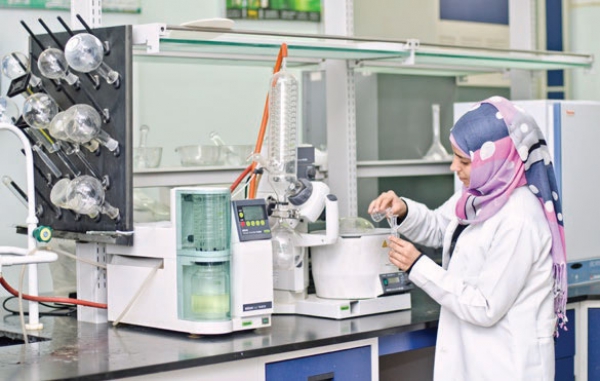
C1. Handle the chemical, biological, and pharmaceutical materials safely, taking into account their physical and chemical properties, including proper operation of pharmaceutical instruments.
C2. Execute the planning, design and carrying out of pharmaceutical research investigations, from the problem-recognition stage through to the evaluation and appraisal of results and findings.
C3. Employ the relevant way of analysis, preparation, determination of quality, and presentation of medicines, by manufacture and extemporaneous dispensing.
C4. Advise the patient and health care professionals on the safe and effective use of medicines as well as developing and supporting therapeutic plans with continuous monitoring with the capability to refer patients to other health care professionals when required.
D. General Skills
D1. Interact effectively with patients, the public and health care professionals; including both written and oral communications. Taking into account the ability to demonstrate sensitivity, respect, and empathy while communicating with diverse groups or individuals.
D2. Retrieve information in relation to primary and secondary information sources, including information retrieval through online computer searches with the ability to analyze the published literature.
D3. Adopt ethical, legal and safety guidelines while maintaining the code of practice.
D4. Develop financial, teamwork, management, decision-making, time management, organization, sales and marketing skills
Upon successfully completing the requirements of the Bachelor of Pharmacy program, graduates will be able to:
- Demonstrate professional knowledge related to the pharmacy profession and pharmaceutical practice.
- Exhibit creative and critical thinking skills in identifying and solving problems associated with drug manufacturing.
- Apply appropriate and fundamental methods, procedures, and modern pharmaceutical resources in the preparation, evaluation, and storage of pharmaceutical formulations.
- Use suitable techniques for drug analysis, preparation, and quality assessment.
- Employ professional skills in safely handling chemical, biological, and pharmaceutical materials.
- Prepare, dispense, and store medications legally, ethically, and in accordance with professional standards.
- Utilize modern information technologies and research skills for professional development and lifelong learning.
- Provide high‑quality pharmaceutical services in collaboration with healthcare providers in other fields.
- Practice leadership, teamwork, decision‑making, sales, and marketing skills.
- Plan, design, and conduct pharmaceutical research.
The Bachelor’s degree is awarded to students who meet the following requirements:
- Successfully completing all courses required for graduation as specified in the study plan.
- Fulfilling the minimum period required for obtaining the degree without exceeding the maximum number of years permitted for graduation according to the academic regulations of the semester system.
- For transfer students, successfully completing no less than 50% of the total credit hours required for graduation, in accordance with the approved study plan at the time of their enrollment at the university.
The Bachelor of Pharmacy program encompasses a wide range of knowledge areas, which can be classified as follows:
- Biomedical and Basic Clinical Sciences
- Basic and Applied Pharmaceutical Sciences
- Pharmaceutical and Technological Sciences (the core of the program)
- Pharmaceutical Practice
- Behavioral, Social, and Administrative Sciences
- Scientific Research Skills and Critical Thinking
There are numerous career opportunities available to graduates of the program. Among the fields in which graduates can work are:
- Working in community pharmacies, whether public or private.
- Working in hospital pharmacies.
- Working as medical representatives or scientific supervisors in pharmaceutical companies.
- Working in pharmaceutical research centers and drug‑control laboratories.
- Academic work as faculty members at universities.
- Working in pharmaceutical manufacturing companies.